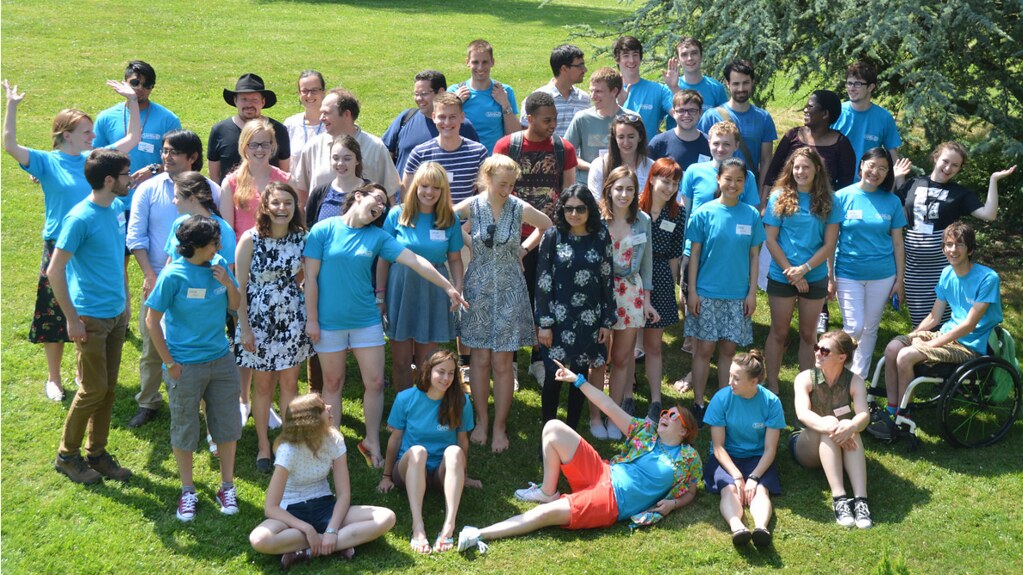
Members
Chris Budd
Jonathan Dawes
Jonathan Evans
Apala Majumdar
Paul Milewski
Harmut Schwetlick
Tony Shardlow
Jey Sivaloganathan
Johannes Zimmer
Continuum Mechanics of Solids and Fluids
Continuum mechanics is concerned with describing the deformation of solids and the flow of liquids and gases. The dynamics of the Earth's atmosphere and oceans is a rich source of mathematical problems. Many problems concern wave motion and the transport of energy: the generation and absorption of waves is central to our understanding of many geophysical phenomena, from under-sea earthquakes to fluctuations in the jet stream in the lower stratosphere.
In addition to geophysical phenomena, our research includes work on problems that lie between traditional fluids and solids, such as viscoelastic fluids, granular materials, porous flows and composites.
Research in continuum mechanics and waves at Bath has broadened considerably in recent years through a number of new appointments and the development of strong links with industry, including in particular the UK Meterological Office. Weekly seminars are held, divided into a formal series with external speakers, and an informal series which both research students and staff contribute to. Regular visitors, with long-standing connections to the Department, include Valery Smyshlyaev and John Willis FRS.

Cloud patterns indicating the generation of large-scale waves in the atmosphere caused by the interaction of air currents above, and downwind of, Amsterdam Island.
The Centre for Nonlinear Mechanics provides a convenient unifying framework for forming research links with other Departments in Bath; notably Mechanical Engineering and Electrical and Electronic Engineering.
Our research in continuum mechanics can be arranged under broad headings as follows:
- Kinetic relations for phase-transforming materials
- Variational problems in nonlinear elasticity
- Singular structures
- Buoyancy-driven instabilities and pattern formation
- Complex fluids
- Liquid crystals
- Geophysical fluid dynamics and waves
Related areas of our research include:
- Analysis and Differential Equations
- Industrial Applied Mathematics
- Mathematical Biology
- Numerical Analysis
Further details of specific research projects are given below.
Solid mechanics
Kinetic relations for phase-transforming materials
Research staff: Johannes Zimmer
Phase transitions in solids can often be described in the framework of evolution equations in elasticity. One particular area of interest to us is the study of a moving interface. Kinetic relations state the dependence of the interface's velocity on the configurational force. A number of successful models in engineering postulate a phenomenological kinetic relation to make the equations of motion on the continuum level well-posed. Our aim is to derive kinetic relations rigorously in the context of the passage from the atomic level to the continuum model.
Variational problems in nonlinear elasticity
Research staff: Jey Sivaloganathan
This research covers a wide spectrum of variational problems arising in nonlinear elasticity. Particular problems of current interest include the existence and properties of singular minimizers and variational models for fracture and defect/crack initiation, cavitation problems with further links to liquid crystals and cavitation in fluids, conservation laws in weak form and symmetries in variational problems, numerical methods to detect singular minimisers.
Singular structures
Research staff: Roger Moser
The properties of materials are often determined to a considerable extent by singular structures. In continuum models based on variational principles or PDEs, these structures often arise as features of the limits for an asymptotic analysis. We aim to derive the form of the singular structures and equations for their behaviour rigorously from the underlying models. The problems studied include Ginzburg-Landau vortices in various contexts, domain walls in ferromagnets, and crystal facets.
Fluid mechanics
Buoyancy-driven instabilities and pattern formation
Research staff: Jonathan Dawes
Many viscous fluid flows are produced by external forces that act on the whole body of fluid, for example gravity. Such external forces drive fluid flow through buoyancy effects due to gradients in temperature or solute concentrations. Often these flows show a spontaneous structure that has features that are experimentally observed not to depend strongly on boundary conditions. Moreover, such flows often undergo qualitative changes (bifurcations) at critical values of control parameters. The investigation of these qualitative changes, and the spontaneous emergence of spatial structure in flow fluids, provides a rich source of mathematical problems, many involving the application of ideas from dynamical systems theory.
Complex fluids
Research staff: Jonathan Evans
The complex fluids of interest are those possessing both solid and liquid like behaviour (i.e. viscoelastic fluids). These fluids have memory which leads to new and intriguing behaviours whilst on the other hand introducing tremendous complications for their mathematical study. Nonlinear differential models are considered which typically describe polymeric fluids such as plastics, oils, paints, biological fluids and foods to name but a few instances of their occurences. Analysis of such models is still in its infancy relative to Newtonian fluids and many important problems remain unsolved. Active research is involved with the use of asymptotic methods to derive approximate solutions in commonly occurring geometries e.g. flow around sharp corners, wedge flows, free surface flows. Technical tools involve matched asymptotic expansions, similarity methods as well as supporting numerical analysis. These tools allow, for example, boundary layer and stability analysis.
Liquid crystals
Research staff: Apala Majumdar
Geophysical fluid mechanics and waves
Geophysical fluid mechanics is a broad research field encompassing spatial scales from wind ripples to planetary circulations and timescales from seconds to climate studies. Our group has expertise in the mathematical study of surface and internal waves and their impact. Surface waves are spectacular, sometimes dangerous and destructive such as in the case of rogue waves and tsunamis, and also are a crucial part of atmosphere-ocean interactions. Although their mathematical study is over a century old, our understanding of more complex and nonlinear phenomena is limited. Analytical and computational issues are extremely challenging, particularly because the boundary conditions are both nonlinear and the boundary motion (the waves themselves) is a priori unknown. Density stratified fluids such as the ocean and atmosphere also support propagating waves. These waves play an important role in energy propagation, dissipation and fluid mixing and are ultimately a crucial ingredient in understanding climate. They are often subject to, and generate their own shear, leading to mathematical issues of stability and well posedness. Breaking internal waves mix the fluid and change the environment upon which they propagate: an extremely challenging problem to model mathematically.
Research staff: Chris Budd, Jonathan Dawes, Paul Milewski