Setting up URB (University Radio Bath)
Stephen Ainger, Physics BSc (1974)
Jonathan White, Electrical & Electronic Engineering MSc (1974)
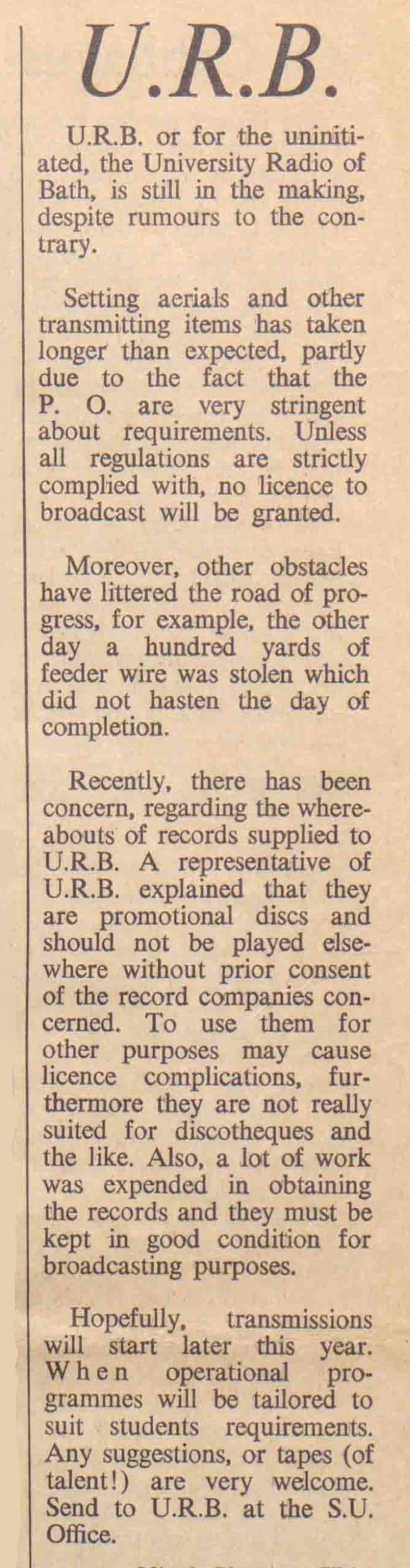
Listen as Stephen Ainger and Jonathan White remember how University Radio Bath all began or read the transcript provided below.
SA: My name’s Stephen Aigner and I studied Applied Physics at Bath University and graduated in 1974.
JW: And I’m Jonathan White and I studied Electrical Engineering and graduated at the same time.
SA: So, Jonathan, how did it all start? How did University Radio Bath begin?
JW: Well, remember in those times, in the 1970s, things were very different as regarding entertainment for students. There was limited access to music. If you wanted to hear pop music, you’d listen to Radio 1. Or you might listen to Radio Luxembourg but there wasn’t much else around. So, the idea of a campus radio, our own radio station, was quite radical really; very exciting.
SA: And could only be delivered by overcoming substantial challenges. You couldn’t go do a web search and buy a mixer desk or a transmitter or even a licence to broadcast. It was all new.
JW: Well, it was and, of course, there was no money. You know, we didn’t have lots of money to set up a radio station; we had very little, so we made do really. We scrounged equipment, we put things together, built a lot of it.
SA: Not forgetting the mixer desk.
JW: Not forgetting the mixer desk, of course, which you built Stephen!
SA: I did. So, the early days where we didn’t have a track record, it was tough, you know, going to ask people for some money or for some help from scratch, but, on the other hand, I have to say the University had a very positive attitude; they would say yes, so when it came to laying cables or finding a studio space, you know, their first reaction was just to say yes.
JW: Well, that’s true, yes. We actually had - our first studio was at the top of a flight of stairs in 2 East building, the Electrical Engineering building, and it was really an access to the roof, but the Works Department put us a partition in with a door and turned it into a little room and that was our studio.
SA: And laying aerials, they were all very positive about that. Just to remind us it was three or four miles of cable, coaxial cable, on the rooftops linking down into little square aerials in all the residential blocks. So, the Works Department were good in saying just don’t put too many holes in the felt top roof.
JW: Well, yeah, I mean they gave access to all the ducts and let us go anywhere we wanted to go really.
SA: And health and safety wasn’t mentioned as I remember!
JW: Don’t remember that bit, no.
SA: But laying cable with that yes attitude we learnt a lot, didn’t we, Jonathan?
JW: We did. We did and I think actually building a station from scratch was amazing. Just the chance to do it was incredible.
SA: And the first year - 1973 - that we broadcast we did a survey of our listenership, and we were equal to Radio 1 which I think was an amazing thing to have achieved.
JW: I think, all in all, we learnt a tremendous lot and it was a privilege to be able to do it. All the work we did outside of our studies in the University, although it took an awful lot of time, was well worth it.
SA: Some of the time we didn’t have!
JW: Yes!
SA: But it was worth it, wasn’t it, and just confirmed the view that doing stuff at the University was just as important as studying for your degree.
JW: Absolutely.