Pollution and our (modern) planet
Alice Glithero, BA (hons) Modern Languages (French and Italian), Department of Politics, Languages & International Studies
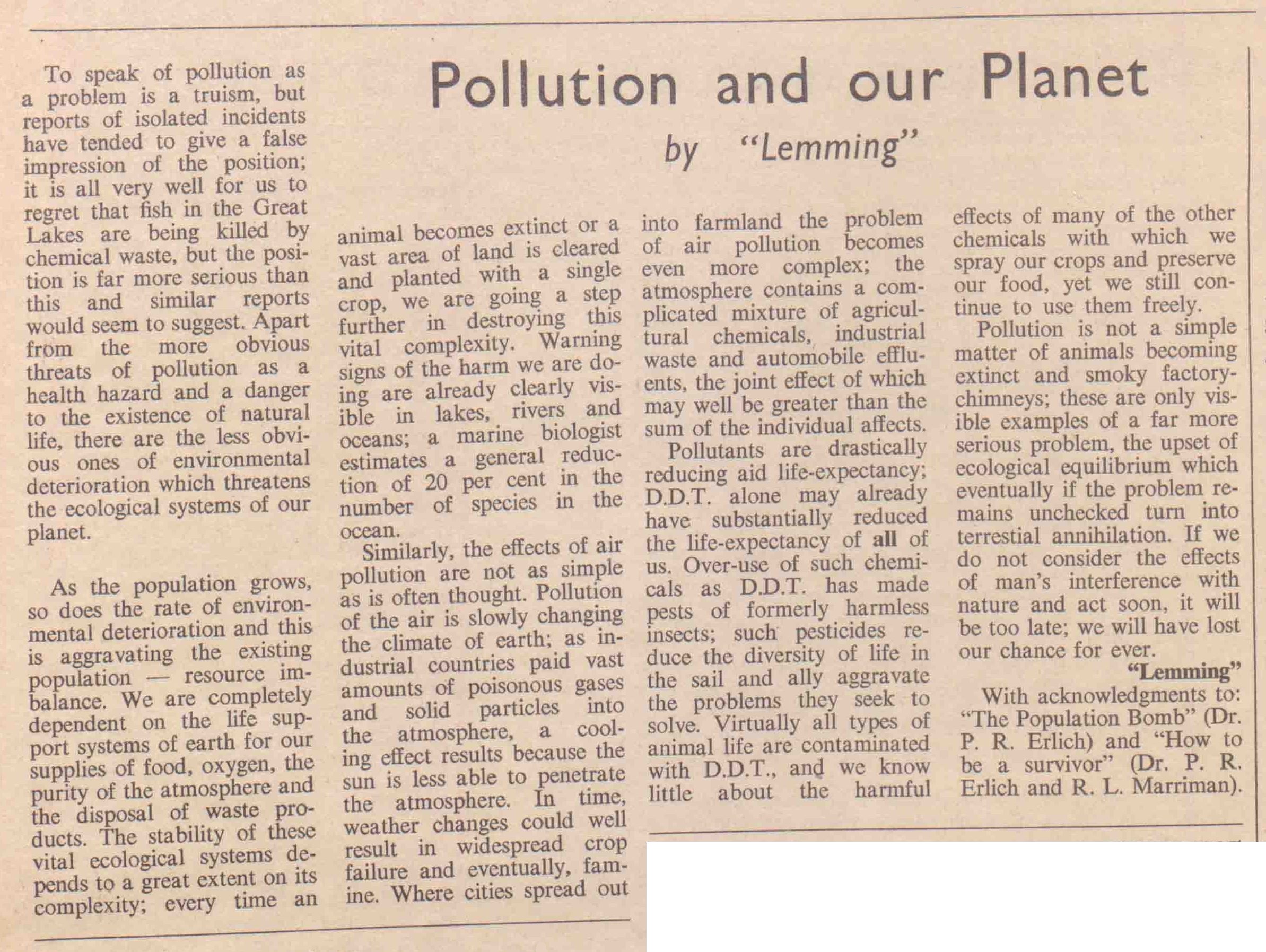
Alice Glithero highlights a worrying lack of progress in attempts to slow environmental deterioration.
55 years on from the publication of this article in 1971, not much has changed. Knowledge certainly has; we have the answer to the dangers of D.D.T. and have witnessed how global warming can now affect crop growth. Climate change still remains a central debate in science and politics but despite having the information that the author of the original article seeks to gain, large parts of what’s written wouldn’t go amiss in a newspaper today.
According to the WWF, global wildlife populations have experienced a 73% decline in average size in the last 50 years. Between 500-1000 known species have become extinct during that timeframe, although the number of unknown species could be higher. The International Union for Conservation of Nature (IUCN)’s Read List of Threatened Species estimates that more than 48,600 species are threatened with extinction and 935 are already considered extinct. The causes haven’t changed much from 1971; deforestation, pollution and habitat destruction are all major contributors to the decline.
Air pollution has become even more cause for concern as our reliance on technology increases. WHO (World Health Organization) data indicates that 99% of the global population breathe air that exceeds their guideline limits and now research allows us to see the devastating effects on human and environmental health. Air pollution accounts for 43% of deaths and disease from chronic obstructive pulmonary disease and 29% of deaths and disease from lung cancer. Byproducts from fossil fuels absorb sunlight and warm the earth’s atmosphere, therefore causing snow and ice to melt faster.
There has at least been one positive development since 1971, and that is the introduction of restrictions on D.D.T. We now have a better awareness of the effects of the chemical, and therefore its application has been heavily restricted under the Stockholm Convention and is now banned for agricultural use in the majority of the world. D.D.T. has been classified as an endocrine disruptor and linked to an increased chance of developing cancer. It is now primarily used for indoor residual spraying, in order to kill mosquitoes that carry malaria, in only five countries.
While there has been at least one positive change since this article was written, we have to wonder that in another 55 years, will this article be one that could still be published?