First encounter with Mr Zhang
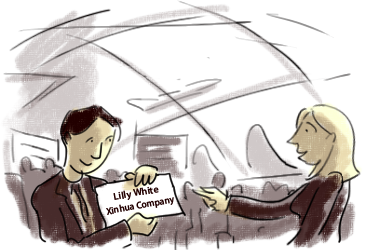
It’s three o’clock in the afternoon. Mr Zhang from Xinhua Company is picking Lilly White up at Shanghai Pudong Airport. He’s holding a piece of paper with Lilly’s name and the company’s name on it.
Click on either pinyin or characters to listen to individual words. The words are listed in the order in which they appear in the dialogue.
Hover the mouse over the Chinese characters for a second to see the pinyin version of that line. You can also click on the right-hand button for all pinyin to be displayed.
Lilly:
您好,我就是Lilly White。
Mr Zhang:
哦,您好,White女士。我是新华公司的,我姓张。我负责接您去宾馆。
Lilly:
谢谢您,张先生,很高兴认识您。
Mr Zhang:
我也很高兴认识您。真没想到您会说中文,而且说得那么好!
Lilly:
没有没有,马马虎虎,我还在学。
Mr Zhang:
您太谦虚了。来,我帮您拿行李。
Lilly:
哦,好的,谢谢。
Mr Zhang:
您的一路顺利吗?
Lilly:
挺顺利的,只是飞机晚到了一个小时,让您久等了。
Mr Zhang:
没关系。您累不累,飞了十几个小时吧?
Lilly:
是的,十二个小时。我不累,我在飞机上睡了一会儿。
Mr Zhang:
中国和英国的时差是几个小时?
Lilly:
时差…… 时差是什么?
Mr Zhang:
就是不同时区之间的时间差别。
Lilly:
哦,我明白了……时差……现在的时差是七个小时,英国比中国晚七个小时。
Mr Zhang:
哦,那您今天一定得好好休息,调整一下时差。
Lilly:
好的。请问宾馆离这儿远吗?
Mr Zhang:
不太远,我们开车一个小时就可以到。
Lilly:
太好了。
Mr Zhang:
您在这里等一下,我去把车子开过来。
Lilly:
好,太谢谢您了。
Lilly:
Hello, I’m Lilly White.
Mr Zhang:
Oh, hello, Ms White. I’m from (lit. of, meaning employed by) Xinhua Company and my surname is Zhang. I am responsible for taking you to the hotel.
Lilly:
Thank you, Mr Zhang, nice to meet you.
Mr Zhang:
Nice to meet you too. I really didn’t expect you to be able to speak Chinese, and to speak it so well!
Lilly:
No, no, just so-so, I’m still learning.
Mr Zhang:
You are too modest. Here, let me take your luggage.
Lilly:
Oh, OK, thanks.
Mr Zhang:
How was your journey (lit. was your journey smooth)?
Lilly:
It was quite good (lit. quite smooth), but the plane was an hour late. Sorry to have kept you waiting.
Mr Zhang:
It doesn’t matter. Do you feel tired? You’ve flown for more than ten hours, haven’t you?
Lilly:
Yes, twelve hours. I’m not tired (though), I slept for a short while on the plane.
Mr Zhang:
What’s the time difference between China and England?
Lilly:
‘Time difference’…, what is ‘time difference’? (Lilly does not understand the Chinese word for ‘time difference’.)
Mr Zhang:
It is the difference between time zones.
Lilly:
Oh, I see. Time difference… The time difference now is seven hours. England is behind (lit. later than) China by seven hours.
Mr Zhang:
Oh, then you should definitely take a good rest today and recover from the jetlag (lit. adjust the time difference).
Lilly:
Yes. May I ask you if the hotel is far from here?
Mr Zhang:
No, not too far. We can drive there in an hour.
Lilly:
That’s great.
Mr Zhang:
Please wait here for a moment. I’ll go and get the car (lit. I’ll go and drive the car here).
Lilly:
OK, thanks a lot.
These are notes about potentially difficult key expressions. They are listed in the order in which they appear in the dialogue. Hover the mouse over the words highlighted in blue for the corresponding word or phrase in the example to appear.
1. 就
a). 您好,我就是Lilly White。Hello, I'm Lilly White.
就 here is used to emphasise, indicating that 'I'm the right person, the one you're expecting'.
b). 我们开车一个小时就可以到。We will be arriving in an hour.
就 here is used to indicate 'soon', 'quick', and 'with ease'.
2. 真没想到
真没想到您会说中文。I really didn't expect you to speak Chinese.
想到 means 'to think of ', 'to expect'. 真没想到 means 'really did not expect…' It can also be used on its own, saying that something, either good or bad, is not expected.真没想到!
3. 没有没有
没有没有,马马虎虎,我还在学。No, no, just-so-so, I'm still learning.
In addition to 哪里哪里, 没有没有, meaning 'no, no', is also a modest way to reply to a compliment. 哪里哪里 sounds old-fashioned.
4. 来
来,我帮您拿行李。Here, let me take your luggage.
来 usually means 'to come' or 'to serve' (in a restaurant). In this instance it's used to offer help, i.e. Give me your suitcase, I'll help you carry it.
5. 只是
挺顺利的,只是飞机晚到了一个小时。It was quite good, but the plane was late by an hour.
只是 means 'but, though'. It is a connector indicating a state of imperfection, and can be put either at the beginning of a sentence or inside a sentence – between the subject and the verb.
e.g. 我很好,我只是有点累。I'm very well, I'm just a bit tired.
6. 之间
就是不同时区之间的时间差别。It is the difference between time zones.
之间 means 'between'. It is always put after the noun/noun phrase.
e.g. 我和他之间有一些误会。Between he and I, there is some misunderstanding.
之 is the ancient Chinese word for '的'.
7. 比
英国比中国晚七个小时。England is behind China by seven hours. (lit. England is later than China by seven hours.)
比 is used for comparison. The word pattern is: A + 比 + B + complement, e.g.
我比他大。I am older than him.
我比他大十岁。I am older than him by ten years.
8. 离
请问宾馆离这儿远吗?May I ask you if the hotel is far from here?
离 is used to talk about distance. The word pattern is: place 1 + 离 + place 2 + distance
e.g. 公司离这儿开车一个小时。It's about an hour's drive from here to the office.
9. 把
我去把车子开过来。I'll go and get the car.
把 is used when the location of the object 车子 is changed in relation to the subject 我.
The pattern is: subject + 把 + object + verb + result.
toggle feedback
Mr Zhang's welcome
Listen to the audios and drag the English translations to match them. You can click on the 帮助 button to access the transcripts of the audios. Check your answers.
1. 张先生做自我介绍
2. 他称赞Lilly的中文好
3. 他帮Lilly拿行李
4. 张先生问Lilly她的一路是否顺利
5. 他问中英时差是多少
-
Mr Zhang introduces himself.
-
He compliments Lilly on her Chinese language ability.
-
He helps Lilly to carry her luggage.
-
Mr Zhang asks Lilly about her journey.
-
He queries about the time difference between China and England.
check Answers