Meeting your line manager and new colleagues
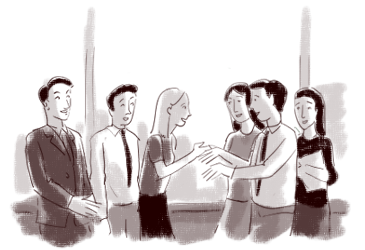
Manager Song introduces Lilly and Yuanfang Chen to other staff in the Sales Department.
Click on either pinyin or characters to listen to individual words. The words are listed in the order in which they appear in the dialogue.
Hover the mouse over the Chinese characters for a second to see the pinyin version of that line. You can also click on the right-hand button for all pinyin to be displayed.
Song:
Lilly,小陈,你们好。我姓宋。欢迎你们加入销售部。我是你们的直属经理。
Chen:
宋经理,您好,很高兴认识您。
Lilly:
您好,宋经理,我很期待在这里的工作。
Song:
太好了。我给你们介绍一下销售部的同事。
各位,我给大家介绍一下我们的两位新同事。这位是陈远方先生,这位是Lilly White女士,她是从英国来的。大家欢迎!
Lilly:
大家好,请叫我莉莉吧。
Chen:
各位好,你们叫我小陈就可以了。
Staff:
你们好!欢迎!欢迎!
Song:
今天很可惜,小吴和小林出差去了,不过他们过两天就回来。
希望大家都能多多帮助我们的新同事。好,打搅各位了,你们继续工作吧。
莉莉,小陈,我带你们参观一下。
Chen:
好的。
Song:
你们都会有自己的座位,也会有自己的电脑和电话。这里是我们的影印室:有两台复印机、一台传真机,和三台打印机,你们随时可以使用。我会给你们安排邮件账号。
这里是一间会议室,我们每周召开一次员工例会。这里是茶水间,有微波炉、饮水机和咖啡机。好了,这里是你们的座位,莉莉,你坐在这儿,小陈,你坐在这儿。你们还有什么问题吗?
Lilly:
宋经理,请问您,大家早上一般几点到办公室?
Song:
一般都是九点左右到,没有规定。有的同事喜欢早到,有的同事家住得比较远,就晚一些到。
Chen:
宋经理,我们的午休时间是怎么样的?
Song:
午休时间也是因人而异的,不过大家一般都在十二点半左右出去吃午餐。公司顶楼有一个员工餐厅。
Chen:
那很方便。
Song:
我们每个月都有餐券。公司的其它员工福利在你们的员工手册里都有说明。
Lilly:
太好了。
Song:
你们很快就会熟悉的。Leon会分配给你们这几天的工作。我回办公室了。再次欢迎你们加入我们公司!有任何问题尽管找我。
Lilly:
谢谢您,宋经理。
Chen:
谢谢您,宋经理。
Song:
不客气。一会儿见。
Song:
Lilly, Xiao Chen, hello. My surname is Song. Welcome to the Sales Department. I am your line manager.
Chen:
Manager Song, hello, nice to meet you.
Lilly:
Hello, Manager Song, I'm looking forward to working here.
Song:
Great. I'll introduce you to your colleagues in the Sales Department.
Everyone, let me introduce our two new colleagues. This is Mr Yuanfang Chen and this is Ms Lilly White, who is from England. Welcome!
Lilly:
Hello everyone, please call me Lilly.
Chen:
Hello everyone, you can just call me Xiao Chen.
Staff:
Hello! Welcome! Welcome!
Song:
Unfortunately Xiao Wu and Xiao Lin are on business trips today, but they'll be back in a couple of days.
I hope everyone will give a lot of help to our new colleagues. OK, sorry for the interruption, you may resume your work.
Lilly, Xiao Chen, I'll show you around.
Chen:
OK.
Song:
You will both have your own desk (lit. seat) with your own computer and telephone. Here is our photocopying room. There are two photocopiers, one fax machine and three printers, which you can use at anytime. I will arrange for you to have your own email account.
Here is a meeting room. We hold a staff meeting once a week (lit. we hold a staff routine meeting once a week). Here is a tea room, with a microwave, a water cooler and a coffee maker. And here are your desks, Lilly, you sit here, Xiao Chen, you sit here. Do you have any other questions?
Lilly:
Manager Song, may I ask what time people usually arrive at the office in the morning?
Song:
People usually arrive at about 9 o'clock, there are no fixed rules. Some colleagues like to arrive early, some colleagues who live far away arrive a bit later.
Chen:
Manager Song, what about our lunch time?
Song:
Lunch time can be different for each individual as well, but people usually go out for lunch at about 12.30pm. There is a staff canteen on the top floor of the building.
Chen:
That's very convenient.
Song:
We have meal coupons every month. Other staff benefits provided by the company are listed in your staff handbook.
Lilly:
Great.
Song:
You will soon become familiar with all this. Leon will allocate you work for today and for the next few days (lit. these days). I'm now going back to my office. Again, welcome to our company! Feel free to call on me if you have any problems.
Lilly:
Thank you, Manager Song.
Chen:
Thank you, Manager Song.
Song:
You're welcome. See you later.
These are notes about potentially difficult key expressions. They are listed in the order in which they appear in the dialogue.
1. 各位
各位,我给大家介绍一下…… Everyone, let me introduce you to…
各位 means 'everyone' and is used as an interjection at the beginning of a speech, a formal announcement, etc. to catch people's attention.
大家 also means 'everyone', but it cannot be used on its own to address people. It is used as part of a sentence (see example above). 大家好 means 'Hello everyone!'.
2. 是……的
她是从英国来的。 She is from England.
The structure 是……的 is used for emphasis. 是 is put at the beginning of the emphasis and 的 is put at the end of the sentence. In the sentence above, '从英国来 come from England' is emphasized.
3. 可惜
今天很可惜…… Unfortunately, today…
可惜 means 'unfortunately (lit. can be regretted)' with 可 meaning 'can' and 惜 meaning 'to regret'. There are a few others words like this: 可爱 lovely (lit. can be loved), 可笑 ridiculous (lit. can be laughed at), 可怜 pitiable (lit. can be felt sorry for).
4. 去
小吴和小林出差去了。 Xiao Wu and Xiao Lin have gone on business trips today.
This is a colloquial use of 去 'to go' put after a verb and indicating movement away from the narrator.
To indicate movement towards the narrator, put 来 after the verb.
In the above sentence, 出差, pronounced as chūchāi, means 'go on a business trip (lit. go for an errand)' where 差 means 'errand '. 差 is pronounced as chà in 差不多 about right.
5. 多多
希望大家都能多多帮助我们的新同事。 I hope everyone will give a lot of help to our new colleagues.
多'a lot' is repeated here for emphasis, this is a colloquial form.
6. 会
你们都会有自己的座位,也会有自己的电脑和电话。You will both have your own desk with your own computer and telephone.
你们很快就会熟悉的。 You will soon become familiar with all this.
The use of 会 here is to express a definite prediction.
7. 室 and 间
这里是我们的影印室。Here is our photocopying room.
这里是一间会议室。Here is a meeting room.
这里是茶水间。Here is a tea room.
室and 间 are used as suffixes for rooms. More examples: 办公室 office (lit. working room) , 休息室 rest room, 卫生间 toilet (lit. hygiene room).
8. 机
有两台复印机、一台传真机,和三台打印机。There are two photocopiers, one fax machine and three printers.
有微波炉、饮水机和咖啡机。 There is a microwave, a water cooler and a coffee maker.
机is used as a suffix for machines. 电视机 TV set (lit. TV machine), 手机 mobile (lit. hand machine), 耳机 headphone (lit. ear machine).
Another suffix for machines is 器, meaning 'tool ', e.g. 计算器 calculator (lit. calculating tool), 热水器 boiler (lit. water heating tool).
The measure word for most machines is 台.
9. 是 and 有
这里是茶水间 。 Here is a tea room.
公司顶楼有一个员工餐厅。 There is a staff canteen on the top floor of the building.
是 and 有 are used to describe a place.
是 indicates the unique occupancy of the described place and 有 indicates the multiple occupancy of the described place.
Compare:
顶楼是一个员工餐厅。 On the top floor of the building there is (only) a staff canteen.
顶楼有一个员工餐厅。 There is a staff canteen on the top floor of the building. (Perhaps a gym as well.)
10. 因人而异
午休时间是因人而异的。 Lunch time can be different for each individual.
因人而异 is a four character idiom (in Chinese:成语), meaning 'different for each individual'.
toggle feedback
Manager Song's welcome
Listen to the six audio bites which are based on the dialogue 'Meeting your line manager and new colleagues', and then put the English translations into the correct order.
You can click on 帮助 to access the Chinese transcripts. Check your answers.
1. 向他们表示欢迎
2. 把他们介绍给同事
3. 叫大家多多帮助他们
4. 带他们参观办公室
5. 把他们带到座位
6. 回答他们的问题
-
He welcomes the new staff
-
He introduces them to colleagues
-
He asks everyone to help them
-
He shows them around the office
-
He takes them to their desks
-
He answers their questions
check Answers