Choosing a gift
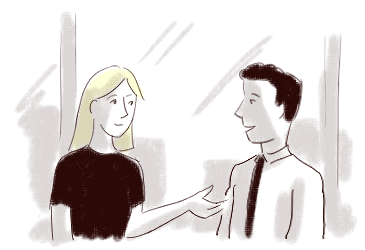
Chen and Lilly talk about what they will take with them when they go to visit Leon.
Click on either pinyin or characters to listen to individual words. The words are listed in the order in which they appear in the dialogue.
Hover the mouse over the Chinese characters for a second to see the pinyin version of that line. You can also click on the right-hand button for all pinyin to be displayed.
Chen:
Lilly,你周六打算带什么去Leon家?
Lilly:
我还没有想过。Leon说我们什么都不需要买。
Chen:
我知道,可是我们应该带一些东西,否则会显得没礼貌。我们合买一件礼物怎么样?
Lilly:
好啊!你想买什么样的礼物呢?
Chen:
你了解Leon平时喜欢什么吗?
Lilly:
我听说他喜欢摄影。
Chen:
也许我们可以给他买个专业相机?
Lilly:
啊,别傻了。相机那么贵。
Chen:
呵呵,我是开玩笑的。对了!我今天在办公室听说他最近刚搬了家。这是他们的新居。
Lilly:
那么我们买一些装饰品,怎么样?
Chen:
嗯,这是个不错的主意。什么装饰品呢?花瓶?
Lilly:
让我想一想…… 相框怎么样?他可以把自己拍的照片放在里面。
Chen:
真是个好主意呀!太棒了!哪里买得到?
Lilly:
公司附近有一个大商场,要不我们今天下班后就去看看?
Chen:
好的,没问题!
Lilly:
我们需要给他的太太也买一份礼物吗?
Chen:
嗯……我觉得这不是必须的。但是,如果我们看到有合适的,也不妨送一份见面礼给她。
Lilly:
好的。他们的女儿这周末不在家,我猜我们就不需要给她买礼物了吧!
Chen:
Lilly, what are you going to take to Leon’s on Saturday?
Lilly:
I haven’t thought about it yet. Leon said we didn’t need to bring (lit. buy) anything.
Chen:
I know, but I think we ought to, otherwise we could appear rude. What about buying a gift together?
Lilly:
Sure. What gift did you have in mind?
Chen:
Do you know what Leon likes?
Lilly:
I hear that he likes photography.
Chen:
Perhaps we can buy him a professional camera?
Lilly:
Ah… Don't be silly! Cameras are much too expensive!
Chen:
Hehe, I was only joking. But listen! I heard in the office today that he recently moved house. This is their new home.
Lilly:
Then shall we buy something decorative?
Chen:
Yes, that is not a bad idea. What kind of decorative thing? A vase?
Lilly:
Let me think… What about a picture frame? He could use it for one of his own photos.
Chen:
That is a really good idea! Great! Where can we find one?
Lilly:
There is a big shopping mall next to the office, shall we go and have a look after work today?
Chen:
OK, no problem!
Lilly:
Do we need to buy a gift for his wife too?
Chen:
Um…I don’t think this is a must. However, if we see something suitable, we might as well get it for her as a first-meeting gift.
Lilly:
OK. I presume since their daughter is not home this weekend, we don’t have to buy her a gift!
These are notes about potentially difficult key expressions. They are listed in the order in which they appear in the dialogue.
1. 过
我还没有想过。I haven't thought about it yet.
过 is put after verbs to indicate finality, to show that the action has been completed, and putting emphasis on the fact. To negate the sentence, put 没 before the verb. 还没 means 'not yet'.
2. 什么都
Leon说我们什么都不需要买。 Leon said we didn’t need to bring (lit. buy) anything.
什么都 here is the indefinite pronoun 'anything, everything'. It is composed of the question word 什么 'what' and 都 'all, both'.
3. 否则……会
我们应该带一些东西,否则会显得没礼貌。 We ought to take something, otherwise (lit. if not) we will appear rude.
否则 means 'if not', and 会 here means 'will', indicating the definite future.
4. 合
我们合买一件礼物怎么样? (lit. What about buying a gift together?)
合 together can be put before a verb (usually a one-syllable verb) to form a new word. Examples of the same construction are: 合租 co-tenancy (lit. rent together), 合唱 chorus (lit. sing together), 合作 co-operation (lit. work together), 合同 contract (lit. agree together).
5. 了解
你了解Leon平时喜欢什么吗? Do you know what Leon likes?
了解 means 'to know well about', it is not to be confused with 认识 'to know (someone personally)' and 知道 'to know (a fact)'.
6. 可以
也许我们可以给他买个专业相机? Perhaps we can/could buy him a professional camera?
可以 'can/could' is used here to indicate suggestion.
7. 别……了
别傻了。Don't be silly. (lit. Stop being silly.)
别 means 'don't' in an imperative sentence. The 了 here is used to imply a change of status. 别……了 means 'stop doing something', e.g. 别说了! Stop talking!
8. 是……的
我是开玩笑的。 I was only joking.
是……的 is used here to emphasize the action of the verb, i.e. the fact that 'I'm joking'.
开玩笑 means 'to make a joke'. 开 is the verb.
9. 对了, 居
对了! 这是他们的新居。 But listen! This is their new home.
对了 is a fixed expression, used when one suddenly recalls something.
居 means 'house'. It's also used in the following compound words: 居民 inhabitant, resident, 居住 to live at, 居委会 residential committee, tenants' association.
10. 呢
什么装饰品呢? What kind of decorative thing?
The particle 呢 is added to the end of the interrogative sentence as a stress mark.
11. 把
他可以把自己拍的照片放在里面。 He can put his own pictures in it. (lit. He can | particle 把 | pictures that he took himself | put at | inside)
The pattern of 把 structure is: subject + 把 + object + verb + result. It is used when the location or the status of the object is changed by the subject.
12. 买得到
哪里买得到? Where can we find one?
The structure 买得到 is 'verb + 得 + resultative ending'. '得 + resultative ending' is used to indicate a positive potential. 到 is used as a resultative ending, meaning 'to attain a goal, to acquire'.
13. 要不
要不我们今天下班后就去看看? Shall we go and have a look after work today?
要不 means 'what about', and is used to introduce a suggestion. Note that this suggestion needs to be a sentence.
14. 我觉得这不是必须的。
I don't think this is a must.
Note that contrary to English, the negation is in the relative clause rather than in the main clause.
English: 'I don't think this is a must.'
Chinese: 'I think this is not a must.'
15. 也不妨
……也不妨送一份见面礼给她。 …(We) might as well give her a first-meeting gift.
也不妨 means 'might as well'.
Fill in the gaps
Listen to the dialogue 'Choosing a gift' and complete the following paragraph by dragging the suitable expressions into the blanks. You can listen to the audio to check your answers. Click on 帮助 if you need to see English translation.
You require the latest flash player to view this activity