Chatting over a meal
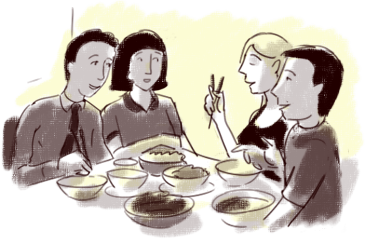
Lilly and Chen are at Leon's place. They are having a chat with Leon and his wife Ying over the meal.
Click on either pinyin or characters to listen to individual words. The words are listed in the order in which they appear in the dialogue.
Hover the mouse over the Chinese characters for a second to see the pinyin version of that line. You can also click on the right-hand button for all pinyin to be displayed.
Ying:
小陈,你觉得这些大闸蟹怎么样?挺不错的吧?
Chen:
嗯,真不错,谢谢你! 吃得出来蟹肉非常新鲜,原汁原味。
Ying:
Lilly,你觉得怎么样,吃饱了吗?
Lilly:
嗯,我吃饱了。吃的时候有点麻烦,不过真的很鲜美。
Ying:
Lilly,你可以用手拿着吃,没有关系!
Lilly:
好的,谢谢。这样的确容易多了!
Leon:
你们西方人用刀叉吃饭,我们中国人用筷子吃饭。你用得惯筷子吗?
Lilly:
用得惯,我用得还不错!因为现在英国有很多中餐馆、中餐外卖,日式面馆等等,所以我有很多机会练习如何使用筷子。
Leon:
啊,原来是这样。
Ying:
Lilly,你可以把蟹肉放在醋里蘸一下,这样味道更好。
Lilly:
好的,我试一试。这是什么?
Ying:
这是花生酱。你要不要试一下?
Lilly:
哦,不要,谢谢。我对花生过敏。
Ying:
真的吗?那你一定得小心一点。中国的烹饪里常常用到花生,比如宫保鸡丁,四喜烤麸。我们也常常用花生油。
Lilly:
对,我知道。谢谢你的提醒。
Leon:
英国买得到螃蟹吗?
Lilly:
买得到,但是不如这里那么常见。英国人更喜欢买已经制成的蟹肉棒!
Leon:
我觉得英国人很喜欢吃牛肉,是这样的吗?我们听说英国女王的皇家卫队就被称为“吃牛肉的人”!
Chen:
哈哈,没错。很多英国人都喜欢吃牛排!
Ying:
我们也吃牛肉,但是我们喜欢把肉切成肉丁、肉片,不像英国人那样爱吃牛排。
Lilly:
我听说中国人还吃蛇肉,甚至青蛙。是真的吗?
Leon:
是的,中国的饮食文化很丰富,不同的地方有不同的菜系。
Ying:
小陈,你的老家在哪里?我听你的口音不像本地人。
Chen:
是的,我是香港人。有机会的话,我们可以一起去一家港式茶餐厅吃点心!
Ying:
Xiao Chen, what do you think of these Chinese crabs? They are good, aren't they?
Chen:
Yes, really good, thank you! You can tell they are very fresh, with a lovely flavour.
Ying:
Lilly, how do you find them, have you had enough?
Lilly:
Yes, I’m full. They are a bit difficult to eat, but they are really tasty.
Ying:
Lilly, please use your hands, we don't mind!
Lilly:
OK, thank you. It does make it a lot easier!
Leon:
You Western people use a knife and a fork to eat, we Chinese use chopsticks. Are you getting used to chopsticks?
Lilly:
Yes, I think I am pretty good at it! Nowadays in England there are many Chinese restaurants, Chinese take-aways, Japanese-style noodle restaurants, etc., so I have had many opportunities to learn how to use chopsticks.
Leon:
Ah, so that’s how it is.
Ying:
Lilly, you can dip the crab meat in the vinegar, it does taste better.
Lilly:
OK, I’ll have a try. What is this?
Ying:
This is peanut butter. Do you want to try it?
Lilly:
Oh, no, thanks. I’m allergic to peanuts.
Ying:
Really? Then you must be very careful. Peanuts are frequently used in Chinese cooking, such as Kung Pao Chicken, Four-Happiness Bran Dough. Peanut oil is often used too.
Lilly:
Yes, I know. Thanks for reminding me.
Leon:
Can you buy crabs in England?
Lilly:
Yes, but they are not as popular as here. The English prefer to buy ready-prepared crab sticks!
Leon:
I think English people are very fond of beef. Is that right? We have heard that the Queen's own guards are called ‘beefeaters’!
Lilly:
Haha, that’s right. The English do like their steaks!
Ying:
We also eat beef, but we like it diced or sliced, not like you and your steaks!
Lilly:
Is it true that Chinese people also eat snakes, even frogs?
Leon:
Yes, Chinese food culture is very versatile, with different regions having different types of cuisine.
Ying:
Xiao Chen, where is your hometown? From your accent, I can tell you are not local.
Chen:
Correct. I’m from Hong Kong. Perhaps one day (lit. if there’s a chance) we could all go to a Cantonese tea restaurant to have some dim-sum!
These are notes about potentially difficult key expressions. They are listed in the order in which they appear in the dialogue.
1. 觉得……怎么样
你觉得这些大闸蟹怎么样? What do you think of these Chinese crabs? (lit. You | think | these Chinese crab | how about)
你觉得……怎么样 means 'what do you think of…'. 觉得 means 'to feel, to think', 怎么样 means 'how about'.
2. 吃得出来
吃得出来蟹肉非常新鲜,原汁原味。 You can tell the crabs are very fresh, with a lovely flavour.
The structure 吃得出来 (lit. eat | particle 得 | coming out) is 'verb + 得 + resultative ending'. '得 + resultative ending' is a pattern used to indicate a positive potential. 出来 coming out is used here figuratively as a resultative ending, implying 'coming into view or being found out'. This use can be applied to other verbs, e.g. 猜得出来 can be guessed, 想得出来 can be thought of, etc.
原汁原味 (lit.original juice, original flavour) is a four-character idiom meaning 'of the original taste and flavour'.
3. 吃饱
吃饱了吗?我吃饱了。Have you had enough? Yes, I'm full.
吃饱 means 'to eat until full'. The result indicator 饱 'full' is attached to the action verb 吃 to eat.
4. 着
你可以用手拿着吃。(lit. You can use your hands to eat.)
着 here indicates manner '用手拿 holding'. It comes before the main verb 吃 to eat.
5. 的确
这样的确容易多了!It indeed makes it a lot easier!
的确 is pronounced 'díquè' and means 'indeed'. It can be put before verbs and adjectives.
的确是这样!It indeed is!
的确很容易!It indeed is very easy!
6. 用得惯
你用得惯筷子吗? Are you getting used to chopsticks?
The structure 用得惯 (lit. use | grammar particle 得 | be used to) is 'verb + 得 + resultative ending'. 惯 is used here as part of a resultative ending and means 'to get used to/to be familiar with'.
7. 如何
我有很多机会练习如何使用筷子。 I have had many opportunities to practise how to use chopsticks.
如何 means 'how' in a written register. 怎么 is another way of saying 'how', but in a less formal register.
8. 把
你可以把蟹肉放在醋里蘸一下。 You can dip the crab meat in the vinegar.
我们喜欢把肉切成肉丁、肉片。 We like the meat to be diced or sliced.
The pattern of the 把 structure is: subject + 把 + object + verb + result. It's used when the location or the status of the object is changed by the subject.
9. 试一试,试一下
我试一试。 I'll have a try.
你要不要试一下? Do you want to try it?
A single-syllable verb is often used in the structures 'V+一+V' and 'V+一下', to denote a short duration, the easiness of the action, or the casualness of the speaking.
10. 对……过敏
我对花生过敏。I am allergic to peanuts. (lit. I | to | peanut | allergic)
对……过敏 means 'to be allergic to'. 对 is used as the preposition 'to'. 过敏 means literally 'excessively sensitive'.
11. 用到
中国的烹饪里常常用到花生。 Peanuts are frequently used in Chinese cooking.
到 here is used as a result indicator, attached to the verb 用 to use, specifying that 花生 peanut would be used in these dishes. More examples of using 到 as a result indicator are:
听 to listen to |
听到 to hear |
买 to buy |
买到 to purchase (lit. to get hold of) |
想 to think |
想到 to think of |
12. 买得到
英国买得到螃蟹吗? Can you buy crabs in England?
The structure 买得到 is 'verb + 得 + resultative ending (the two last components here indicating potential)'. It implies 'to get hold of'. 到 is used as a resultative ending, meaning 'to attain a goal, to acquire'. The opposite is 不到 cannot acquire.
13. 不如……那么
不如这里那么常见。 They are not as popular as here. (lit. not as | here | so | popular)
不如……那么 means 'not as…as'. Please note that on its own 那么 means 'so'.
14. 被称为
我们听说英国女王的皇家卫队就被称为"吃牛肉的人"! We have heard that the Queen's own guards are called 'beefeaters'!
被 'by' is put before the verb in the passive voice. It doesn't have to be accompanied by an agent. 称 means 'to call, to name' and 为 means 'as'.
被称为 means 'to be called as'.
15. 如果……的话
如果有机会的话…… If there's a chance…
如果……的话 means 'if'. Either 如果 or 的话 can be omitted.
Hence both 如果有机会…… or 有机会的话…… mean 'if there's a chance…'
Fill in the gaps
Listen to the dialogue 'Chatting over a meal' and retell the story. Click on the gaps and select the correct options. You can listen to the audio to check your answers. Click on 帮助 if you need to access the English translation.
hint 1
Part 1
星期六,小陈和Lilly在Leon家 。他们一起吃大闸蟹。小陈觉得蟹肉非常 , 。Lilly也觉得味道 ,只是吃的时候 。Leon的太太担心Lilly用不惯 ,建议她用 拿着吃。Lilly告诉他们说,英国现在有很多中餐 、日式 等,因此她有很多机会练习 使用筷子。
On Saturday, Chen and Lilly went to visit (lit. be a guest) Leon. They ate Chinese crabs together. Chen found the crab meat very fresh, with a lovely flavour. Lilly also found them tasty, but a bit difficult to eat. Leon’s wife was worried that Lilly was not used to chopsticks, so she suggested using her hands. Lilly told them that nowadays in England there are many Chinese take-aways, Japanese-style noodle restaurants, etc., so she had had many opportunities to practise how to use chopsticks.
check Answers
reset Answers
Fill in the gaps
Listen to the dialogue 'Chatting over a meal' and retell the story. Click on the gaps and select the correct options. You can listen to the audio to check your answers. Click on 帮助 if you need to access the English translation.
hint 2
Part 2
Lilly对花生 ,因此她不能吃 ,也不能吃宫保 等。Leon问Lilly在英国是否买得到 ,她说 ,可是不如在中国那么 。他们还提了中英两国在 牛肉上有何不同:中国人喜欢把牛肉切成 和 ,英国人喜欢吃 。 Leon说,中国有丰富的 ,不同的地方有不同的 。 小陈告诉大家他是香港人,并 大家以后一起去港式 吃 。
Lilly is allergic to peanuts, so she cannot eat peanut butter, nor can she eat Kung Pao Chicken, etc. Leon asked Lilly if you can buy crabs in England, she said yes (lit. can buy), but they were not as popular as in China. They also mentioned the difference between China and England in cooking beef: Chinese people like it diced or sliced, while English people like steaks. Leon said that China has a versatile food culture, with different regions having different types of cuisine. Chen told everyone that he was from Hong Kong, and suggested that they could all go to a Cantonese tea restaurant to have dim-sum.
check Answers
reset Answers