An overview of financial China
Chinese banks
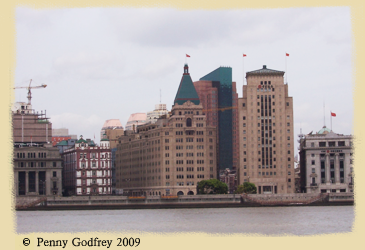
The 'big four' Chinese banks are:
- Industrial and Commercial Bank of China (ICBC) 中国工商银行.
- China Construction Bank (CCB) 中国建设银行.
- Bank of China (BOC) 中国银行.
- Agricultural Bank of China (ABC) 中国农业银行.
They all have numerous branches and you can easily find one in any Chinese town or city. In 1995, the Chinese Government introduced the Commercial Bank Law to commercialise the operations of the four state-owned banks.
Now the 'big four' banks have become state-controlled shareholding commercial banks 国家控股商业银行.
The People's Bank of China (PBOC) 中国人民银行 is the central bank of the People's Republic of China.
Most banks in China accept US dollars 美金, HK dollars 港币 and RMB 人民币 (Chinese yuan). Cash deposits in these currencies are always accepted. Banks also endorse bank drafts in other currencies.
Foreign banks
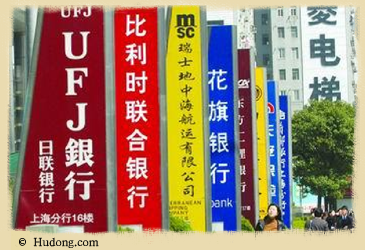
There are many foreign banks in China. For example:
- Standard Chartered Bank 渣打银行.
- Citibank 花旗银行.
- ABN-AMRO Bank 荷兰银行.
- HSBC 汇丰银行.
- RBS 苏格兰皇家银行.
- Deutsche Bank 德意志银行.
- Bank of America 美国银行, etc.
The first foreign bank to trade in China after the Second World War was the Export-Import Bank of Japan 日本输出入银行, which set up an agency in Beijing in 1979. Numerous foreign banks have appeared in China since the country joined the WTO (World Trade Organisation) in 2001. They are mostly located in major cities such as Beijing, Shanghai, Guangzhou, Shenzhen, etc. The 'Bund' area of Shanghai alone houses a dozen foreign banks.
Opening a bank account

It is very easy for foreigners to open a bank account 银行账户 in China nowadays. You simply walk into a branch with your passport, fill in a form given to you by a Personal Financial Consultant 个人理财顾问, and your account is ready within half an hour. You don't have to be a permanent resident or an employee in China to apply for a bank account there. Even tourists are advised to open an account for easy access to cash and to avoid expensive international withdrawal charges.
To accompany your new bank account, you're usually given a savings book 存折 and a debit card 借记卡. Note that foreigners are seldom granted a credit card 信用卡. Cheques are not popular in China and would only be used by some affluent people making a substantial purchase or for business deals.
The Chinese attitude to money
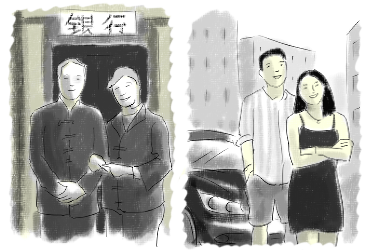
勤俭节约 'diligence and frugality' have long been regarded as virtues in China. The older generation likes to save every penny they can, deposit their money in the bank, and refrain from spending money on luxurious or 'unnecessary' items. This is partly due to the still relatively underdeveloped social welfare system, especially when it comes to pension schemes and the cost of medical care. Most people still have to save money so that they can support themselves after retirement, or when they have overspent their medical care allowance. People are still wary of borrowing, and will only make a large purchase, such as a flat, when they can afford the full price. To be in debt is still frowned upon.
To some members of the younger generation, however, 花明天的钱 "spending tomorrow's money" has gradually become a way of life. They are the owners of a couple of credit cards, and are known as 月光族 (this is a play on words, based on the double meaning: 'moonlight group' and 'monthly used-up group'). They are big spenders not only on daily necessities, but also on holidays, luxuries, etc. They seem to 'live for the moment' 活在当下 and have little worry about the future, in total contrast to their elders.
Chinese currency
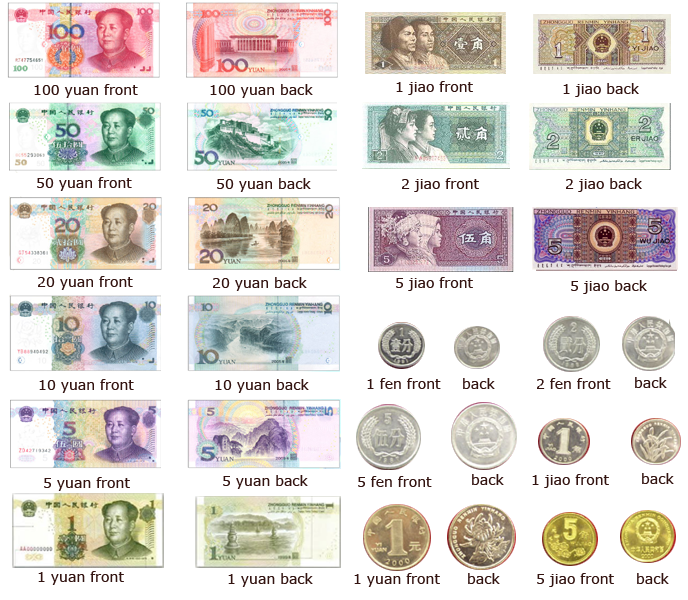
The Chinese currency is officially called the Renminbi (RMB) 人民币, meaning the "People's currency". The sign for RMB is ¥.
| Units | Value | Denominations |
| 元 (can also be called 块) |
1 yuan = 10 jiao ¥ 1 |
100, 50, 20, 10, 5 and 1 yuan bank notes 1 yuan coin |
| 角 (can also be called 毛) |
1 jiao = 10 fen ¥ 0.10 |
5, 2 and 1 jiao bank notes 5 and 1 jiao coins |
| 分 | lowest unit ¥ 0.01 |
5, 2 and 1 fen coins |