Flat hunting – the visit
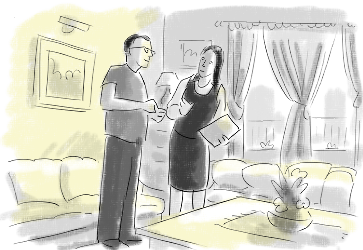
The estate agent takes Xiao Fang round to visit a flat.
Click on either pinyin or characters to listen to individual words. The words are listed in the order in which they appear in the dialogue.
Hover the mouse over the Chinese characters for a second to see the pinyin version of that line. You can also click on the right-hand button for all pinyin to be displayed.
Agent:
那么,你觉得这套房子怎么样?
Xiao Fang:
房子装修得很有品味,挺有欧式风格的!
Agent:
是呀,这家房东对装修的要求很高,家具都是他亲自精挑细选的。他两年前因为工作原因搬去美国了。
Xiao Fang:
我觉得房子的总体面积小了点儿。
Agent:
这的确是一套小型的一室一厅,不过厨房和浴室都是标准大小。这类房子精巧、实惠,也很舒适,很受“单身贵族”的欢迎。
Xiao Fang:
请问你房租怎么付?
Agent:
房租是“付三押一”,也就是签合同时一次性付三个月的房租和一个月的押金。这是统一做法。
Xiao Fang:
好的。请问现在的房客什么时候搬走?
Agent:
现在这位房客的合同到这个月月底结束,你可以在下个月月初搬进来。
Xiao Fang:
他在这儿住了多久了?
Agent:
他在这儿住了两年。最近他好像自己买了一套房子,所以要搬走了。
Xiao Fang:
这里的物业管理怎么样?
Agent:
这个小区的物业管理非常好。物业管理费已经包括在房租内了。
Xiao Fang:
哦,小区的保安怎么样?
Agent:
这个小区的大门有二十四小时的保安,整个小区都有录像监控设备。
Xiao Fang:
谢谢您的介绍。我能不能看看别的两套,然后再做决定?
Agent:
当然,不过看这套房子的人很多,如果您真的感兴趣,最好尽快给我答复。
Agent:
So then, what do you think of this flat?
Xiao Fang:
It's very tastefully decorated; I think it's got some kind of European style!
Agent:
Yes, the landlord has very high decorative standards. He personally chose all the furniture very carefully. He had to move to America for his job two years ago.
Xiao Fang:
I'm worried that the flat is a bit small for me though.
Agent:
I admit this is a small, one-bedroom flat; but the kitchen and bathroom are of a normal size. So it is a compact, functional and comfortable flat and this type is very popular among the 'Single Nobles'.
Xiao Fang:
Can you tell me how the rent is paid?
Agent:
It is a 'pay three deposit one' scheme, that is you pay the rent for the first three months in advance plus the deposit which is a month's rent. This is standard practice.
Xiao Fang:
Thanks. Do you know when the current tenant is going to move out?
Agent:
The contract for the current tenant finishes at the end of this month; you would be able to move in at the beginning of next month.
Xiao Fang:
How long has he stayed here?
Agent:
Two years. It seems that he has recently bought his own flat and is therefore moving out.
Xiao Fang:
What about the property management service for this place?
Agent:
The property management service in this complex is excellent. The fee is already included in the rent.
Xiao Fang:
Oh, how about the security in the complex?
Agent:
The complex's main gate has a 24-hour security guard, and the whole area is equipped with CCTV.
Xiao Fang:
Thanks for all this information. Could I see the other two flats before I make a decision?
Agent:
Sure, but there are quite a few people viewing this flat. If you decide you are interested, you'd better let me know as soon as possible.
These are notes about potentially difficult key expressions. They are listed in the order in which they appear in the dialogue.
1. 有品味
房子装修得很有品味。The flat is very tastefully decorated.
有品位 means 'tasteful '. It is composed of 有 'to have' and 品味 'taste'. 有 is often put before a noun or a verb to form an adjective, e.g.:
有意思 interesting (lit. have | meaning)
有钱 rich (lit. have | money)
有用 useful (lit. have | use)
有帮助 helpful (lit. have | help).
2. 式
挺有欧式风格的!It has got some kind of European style!
式 is a suffix for 'style' and is used with one-syllable words, e.g.: 中式 Chinese style, 西式 western style, 新式 modern style, 老式 old-fashioned style.
The specific word for 'style' is 式样. What style is this? 这是什么式样的?
3. 精挑细选
精挑细选 is a four-character idiom meaning 'carefully selected '. Both 精挑 and 细选 literally mean 'to carefully choose'.
4. 是……的
家具都是他亲自精挑细选的。He personally chose all the furniture very carefully.
This sentence is a typical Chinese 'topic-comment' structured sentence:
家具 'furniture' is the topic here and thus is put at the beginning of the sentence.
他亲自精挑细选 'he personally carefully chose' is the comment part of the sentence which gives new information about the topic and thus follows it.
These two parts are connected by 是……的.
5. 搬
他两年前搬去美国了。He moved to America two years ago.
他要搬走了。He is going to move away.
搬 means 'to move' and must be followed by an object if used on its own.
搬家 to move house, 搬箱子 to move suitcases.
搬去 means 'to move to (a place) '. 搬走 means 'to move away ', and is not followed by a place or an object because it is a transitive verb.
6. 小了点儿
房子的总体面积小了点儿。The flat is a bit small.
了点儿 is used here as an adverbial phrase. It means 'a bit ' and can be put after an adjective.
小了点儿 means 'a bit small '. Similarly, 贵了点儿 means 'a bit expensive', and 吵了点儿 'a bit noisy'.
7. 受
这类房子很受欢迎。This type of flat is very popular.
受 is a passive voice marker, similar to 被.
受欢迎 literally means 'to be welcome'. The difference between 受 and 被 is that 受 is generally used for something positive while 被 indicates something negative, e.g. 他的钱包被偷走了。His wallet got stolen.
8. 一次性
签合同时一次性付三个月的房租。You have to pay the rent for three months in one go when signing the contract.
一次性 means 'one-off ' and can be used as an adverb as in the example or as an adjective, e.g. 你有没有一次性的杯子?Do you have disposable (lit. one-off ) cups?
9. 做法
这是统一做法。This is standard practice.
做法 means 'practice', 'way of doing things'. It is literally 'do | method '.
Similarly:
想法 (lit. think | method) means 'thought '
看法 (lit. look | method) means 'opinion '
说法 (lit. speak | method) means 'argument '
10. 了
他在这儿住了两年。He stayed here for two years.
他在这儿住了两年了。He has stayed here for two years.
他要搬走了。He is going to move away.
When put after the verb, 了 indicates that an action has been completed. When placed at the end of a sentence, 了 indicates a change of status/situation, and puts emphasis on the impact on the present. Thus the second sentence above implies that he is still here today, compared with sentence one, which simply refers to a completed event.
11. 包括
物业管理费已经包括在房租内了。The property management service fee is already included in the rent.
包括 means 'to include' and 在……内 means 'in', 'inside'. The passive voice in Chinese is often not obviously recognisable because the passive voice markers (被, 受, etc.) can be omitted. In this case, the passive voice is clearly deducted from the context.
12. 再
我能不能看看别的两套,然后再做决定?Could I see the other two flats before I make a decision?
再 here does not mean 'again'. It is used to indicate a sequence of actions, i.e. in the example, making a decision will happen after the viewing of the other two flats.
True or False
Listen to the audios and decide whether the statements are true or false according to the dialogue 'Flat hunting – the visit'. You can click on 帮助 to access the Chinese transcript and translation. Check your answers.
hint 2
All the furniture in the flat has been carefully chosen by the owner himself.
hint 4
The agent says that this type of flat is very popular with young families.
hint 7
The tenant is moving out at the end of the current month.
check Answers
reset Answers