Beijing, the capital of China
The Great Wall of China
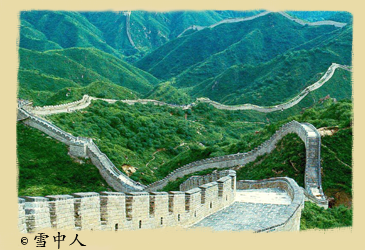
In 1987, UNESCO put the Great Wall 万里长城 on its list of great national and historical sites. The wall is a disconnected network of segments built by various dynasties to protect the northern frontier of imperial China against invasions from nomadic tribes. At approximately 6,400 kms in length it is the longest man-made structure in the world.
During the Ming dynasty (1368-1644), nearly one million soldiers were said to defend the Great Wall against the 'barbarian' tribes. There are more than 10,000 watchtowers and beacon towers along its length. The last battle fought at the Great Wall was in 1938 during the Sino-Japanese War.
Today the Great Wall is the most visited tourist attraction in China. This has generated some concern about the preservation and maintenance of what is considered the main Chinese national symbol.
The Forbidden City
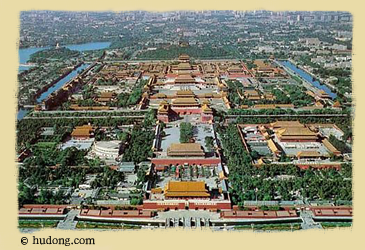
The Forbidden City 紫禁城, also called the Palace Museum 故宫博物馆, is situated in the centre of Beijing where it occupies an area of 72 hectares. It is the largest imperial palace in China. Its construction started in 1406 during the reign of the Yongle emperor, third emperor of the Ming dynasty. Between 1420 and 1923 the palace was home to 24 emperors of the Ming and Qing dynasties. Most of the current buildings date from the Qing rather than the Ming period and include some 9,800 rooms. The last resident was the emperor Aisin-Gioro Puyi, who was forced to abdicate in 1912 but continued to live in the palace until 1924.
The site is at present undergoing a substantial restoration programme. It has been listed by UNESCO as a World Cultural Heritage Site since 1987 and is one of the most visited historical landmarks in the world. The name Forbidden City comes from the fact that for the best part of 500 years the imperial palace was out of bounds to most Chinese people as well as to the outside world.
Beijing
King Wu was the first to declare Beijing the capital city in 1057 BCE. The Ming Dynasty Emperor, ChengZu, chose the name Beijing in 1421. Before the pinyin romanisation was adopted, Beijing was spelt as Peking in the West, but since then 'Beijing' has been increasingly adopted as the city’s official spelling outside China. Since the early 1980s, when China initiated economic and market reforms, Beijing has become a truly modern, international city with a vibrant and exciting environment enjoyed by young and old, Chinese and foreign visitors alike.
There are all kinds of interesting places to visit in the capital including art shops, design galleries, trendy cafés, antique shops, 24-hour restaurants and clubs. Many new Beijingers, originating from all over the world, are now contributing new inspiration and energy to this already extremely rich cultural environment.
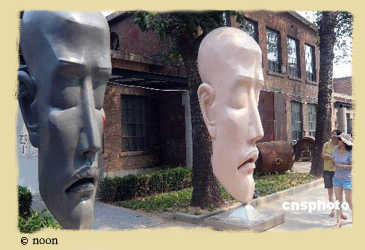
Trendy Beijing includes for example, a thriving artistic community called 798 Art District, 798艺术区, which has become one of the 'must-see' places in the capital. It boasts art studios, workshops, galleries, restaurants, and so on. The building constructed in the Bauhaus style used to be a factory complex before being converted to a cultural centre. Another example is the street called Sanlitun, 三里屯, which gets its popularity from its numerous bars and pubs. The street is close to embassies and therefore foreigners and Chinese people can often be seen drinking and relaxing together in this very lively area.