Planning a holiday
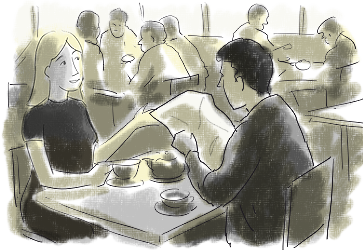
Lilly and Chen are meeting in a tea house to plan their two-week holiday tour of China.
Click on either pinyin or characters to listen to individual words. The words are listed in the order in which they appear in the dialogue.
Hover the mouse over the Chinese characters for a second to see the pinyin version of that line. You can also click on the right-hand button for all pinyin to be displayed.
Chen:
莉莉,看,我带了一份中国地图。我们得先计划一下行程。
Lilly:
好的。你知道吗, 我第一次来中国的时候, 在北京工作。那个时候我没什么时间旅游, 所以中国的很多地方都没去过呢。
Chen:
那我们一定得多去几个地方。我们一共有三个星期的假期,所以可以走远一些。你想先去哪儿?
Lilly:
嗯……我想去杭州。虽然杭州离上海很近,但是我一直没有机会去。杭州不是被称为“人间天堂”吗?我听说那里有一些有名的寺庙。我的朋友们都说杭州是他们在中国最喜欢的城市!
Chen:
没问题,我们可以先去杭州。接下来呢?再去哪儿?我自己很想去北京和西安。可是,莉莉,你愿意再去一次北京吗?
Lilly:
当然!我和以前的几个同事还保持着联系,我很想同他们聚会。而且,在北京,你或许可以带我去一些我以前没去过的地方!
Chen:
好主意!嗯,我还很想去登一下长城。你知道“不到长城非好汉”的说法吧?
Lilly:
知道。是呀,长城非常壮观,绝对值得多去几次。
Chen:
接下来,我们可以飞去西安看兵马俑。我只在书上读过,从没见过真的。
Lilly:
我也是!我觉得在中国旅游的话,一定得去看西安的兵马俑。可是……小陈,我们到那个时候肯定很累了。我们接下来放松一下吧?
Chen:
好啊。我们接下来去海南岛怎么样?我听说那个地方很漂亮。那里有山,有海滩,还有很多阳光。而且,现在正是去中国南部的好时候!
Lilly:
太棒了。听起来真不错!那我们现在得做什么?
Chen:
我会上网查一下,计划一下路线,包括航班和酒店。我们在开始预定之前可以再商量一下。
Chen:
Lilly, look here, I have brought a map of China. We need to plan the itinerary for our holiday first.
Lilly:
OK. You know, when I first came over and was working in Beijing, I didn't have a lot of time to travel so there are many places in China that I haven't been to.
Chen:
Then we should definitely go to as many places as possible. We have three weeks holiday, so we can go to far away places! Where would you like to go first?
Lilly:
Mmm… I think I would like to start with Hangzhou. Although Hangzhou is close to Shanghai, I have never had a chance to go there. Isn't Hangzhou called 'a paradise on earth'? I have heard there are some famous temples there and my friends all say that Hangzhou is their favourite Chinese city!
Chen:
No problem, we can go to Hangzhou first. And then, where next? Personally I would really like to visit Beijing and Xi'an. But Lilly, are you willing to go to Beijing again?
Lilly:
Of course! I am still in touch with a couple of my former colleagues there and I would very much like to see them again. And perhaps you could take me to parts of Beijing I have never been to!
Chen:
That's a good idea! Now, I also would like very much to climb the Great Wall. Do you know the saying 'He who does not reach the Great Wall is not a true man'?
Lilly:
I do. True, the Great Wall is magnificent, definitely worth seeing several times.
Chen:
We could then fly to Xi'an to see the terracotta soldiers. I have only read about them in books, but have never seen them with my own eyes.
Lilly:
Nor me! I definitely think that any tour of China should include a visit to the terracotta soldiers! But Chen, we are going to be exhausted by then…! Could we do something relaxing next?
Chen:
Sure. How about going to Hainan Island? I hear that it is a very beautiful place. There are mountains as well as beaches, and there is a lot of sunshine. Moreover, it is a very good time of the year to visit the southern part of China!
Lilly:
Great. It all sounds really exciting. What do we do now?
Chen:
I'll check online and will plan a route including flights and hotels. We can discuss it all again before making the bookings.
These are notes about potentially difficult key expressions. They are listed in the order in which they appear in the dialogue. Hover the mouse over the words highlighted in blue for the corresponding word or phrase in the example to appear.
1. 份
我带了一份中国地图。I have brought a map of China.
份, lit. portion, is used here as a measure word, meaning 'copy'. Another measure word for map is 张 piece, which can also be used for paper, disc, etc. as exemplified below
| 份 (lit. portion) | 张 (lit. piece) |
| 一份报纸 a newspaper copy | 一张海报 a poster |
| 一份资料 a copy of the documents | 一张便条 a brief note |
2. 得,一下
我们得先计划一下行程。We need to plan the itinerary for our holiday first.
得 here is pronounced as 'děi'. It is a modal verb, meaning 'to have to'.
一下 is used as a measure word for actions, meaning 'once'. It is put after the verb, indicating the idea of 'doing something once' and implying casualness, quickness.
3. 没什么
那个时候我没什么时间旅游。I didn't have a lot of time to travel then.
没什么 means 'not to have many/much…'. 没什么时间 means 'not to have much time'. Other examples are: 没什么人 not to have many people, 没什么问题 not to have many problems.
4. 走远一些
我们可以走远一些。We can go to far away places!
走远一些 means 'to go a bit far'.
远一些, meaning 'a bit far', is put after the verb 走 'to go', to complement the action.
5. 离……很近
杭州离上海很近。Hangzhou is close to Shanghai.
离……很近 means 'to be close to'. The opposite is 离……很远 'to be far away from'.
The particle 离 is used to talk about distance.
The word pattern is: place 1 + 离 + place 2 + distance.
杭州离上海有多远。How far is Hangzhou from Shanghai?
杭州离上海有200公里。Hangzhou is 200 kilometres away from Shanghai.
6. 被
杭州不是被称为“人间天堂”吗?Isn't Hangzhou called 'a paradise on earth'?
被 is a passive voice marker put before the verb. 被称为 means 'to be called as'.
Note that the passive voice is not used very often in Chinese. As long as the passive meaning is clear from the context, the passive voice marker is usually omitted as in the following example:
老房子拆掉了。Old houses are demolished.
拆掉 to demolish follows directly after the subject 老房子 old houses.
7. 接下来
接下来呢?再去哪儿?And then, where next?
接下来 indicates a sequence and means 'then'. 接着 and 然后 are two other connectors meaning 'then'.
8. 着
我和以前的几个同事还保持着联系。I am still in touch with a couple of my former colleagues.
The aspect marker 着 is put after the verb 保持 to keep. It is used to put emphasis on the ongoing duration of the action taking place in the present time.
9. 不到长城非好汉
你知道"不到长城非好汉"的说法吧?Do you know the saying 'He who does not reach the Great Wall is not a true man'?
不到长城非好汉 comes from a poem by Chairman Mao in 1935. It was meant to encourage the Red Army to complete the Long March despite many difficulties. Nowadays this expression is quoted to express one's determination.
10. 值得
绝对值得多去几次。It is definitely worth seeing several times.
值得 means 'to be worth'. Note that 得 is pronounced as 'dé' here.
11. 过
我只在书上读过,从没见过真的。I have only read about them in books, but have never seen them with my own eyes.
The aspect marker 过 conveys the meaning that the action of the verb has already been experienced in the past. It is put after the verb. 读过 to have read. 见过 to have seen. To negate, put 没(有) before the verb. 没读过 to have not read. 没见过 to have not seen.
12. 的话
我觉得在中国旅游的话,…… I think if one travels around China, ...
如果……的话 means 'if', 如果 is put before the verb and 的话 is put at the end of the sentence. Please note that either of them can be omitted as exemplified above.
13. 会
我会上网查一下。I'll check online.
会 here does not mean 'can'. It is used to express a definite prediction.
Fill in the gaps
Listen to the dialogue 'Planning a holiday' and complete the following paragraph by dragging the suitable words into the blanks. You can listen to the audio to check your answers. Click on 帮助 if you need to see the English translation.
You require the latest flash player to view this activity

True or False
Decide whether the following statements are true, false or not mentioned in the dialogue 'Planning a holiday'. Click on the audio button to hear each statement. You can also click on 帮助 to see the English translation. Check your answers.
hint 2
There are many places in China that Lilly hasn't visited.
hint 3
There are many places in Beijing that Chen hasn't visited.
hint 5
Lilly thinks that anyone travelling in China should climb the Great Wall.
hint 7
Hainan Island is an island off the coast of southern China.
hint 8
Chen plans to book flight tickets and hotels straightaway.
check Answers
reset Answers