Yin and Yang
Yin and Yang
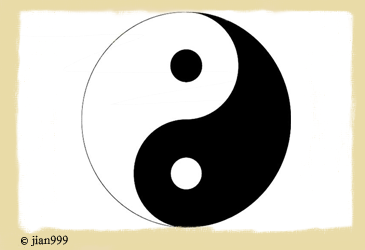
Traditional Chinese Medicine 传统中医 is inspired by the Taoist philosophy which sets the order and unity of the cosmos as its foremost principle. This order and unity depend on the happy balance between Yin 阴 and Yang 阳, the two opposite components of all universal elements. As a general rule Yin forces manifest themselves through passivity while Yang forces manifest themselves through movement. Although it does appear that Yin and Yang are in conflict, in fact they are at the same time totally interdependent. Traditional Chinese Medicine sets out that disease will occur when the balance between Yin and Yang has been disturbed.
Traditional Chinese Medicine has also adopted the theory of the Five Elements 五行 from Taoist philosophy. These Five Elements are: metal 金, wood 木, water 水, fire 火, and earth 土. They are considered to be the principle constituents of the physical universe.
The following table shows the interpretation of the properties of the Five Elements and their metaphorical associations.
Flavours 味 |
pungent 辛 |
sour 酸 |
salty 咸 |
bitter 苦 |
sweet 甜 |
Internal organs 脏 |
lung 肺 |
liver 肝 |
kidney 肾 |
heart 心 |
spleen 脾 |
Abdominal organs 腹 |
large intestine 大肠 |
gallbladder 胆 |
urinary tract 膀胱 |
small intestine 小肠 |
stomach 胃 |
Senses 五官 |
nose 鼻 |
eye 目 |
ear 耳 |
tongue 舌 |
mouth 口 |
Tissue 组织 |
hair/skin 发/肤 |
tendon 筋 |
bone 骨 |
blood vessel 血 |
muscle 肌 |
Direction 方位 |
west 西 |
east 东 |
north 北 |
south 南 |
centre 中 |
Changes 变化 |
reap 收获 |
germinate 萌芽 |
store 存储 |
grow 生长 |
transform 转变 |
Colour 色 |
white 白 |
green 青 |
black 黑 |
red 赤 |
yellow 黄 |
As for Yin and Yang, pathological changes can be explained and complications predicted when the various elements have been unbalanced or disturbed.