Reporting sick
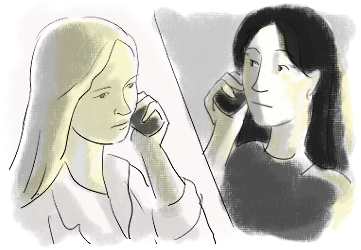
Lilly has gone out for dinner with her colleagues and feels unwell the next morning. She phones her colleague Wu and tells her that she will not be able to come to the office on that day.
Click on either pinyin or characters to listen to individual words. The words are listed in the order in which they appear in the dialogue.
Hover the mouse over the Chinese characters for a second to see the pinyin version of that line. You can also click on the right-hand button for all pinyin to be displayed.
Wu:
你好,我是小吴。
Lilly:
喂,小吴,我是莉莉。
Wu:
啊,莉莉,你好,早上好。
Lilly:
早上好,小吴。我给你打电话是想说,我今天不能去办公室了,我有点儿不舒服。你能帮我向宋经理请个假吗?
Wu:
哦,莉莉,你怎么了?严重吗?
Lilly:
不是很严重,不过我从昨天晚上开始就觉得肚子有点儿不舒服。
Wu:
是因为昨天晚上吃的东西吗?你有些什么症状?有没有拉肚子?
Lilly:
有,我还觉得有点恶心。我昨天吃完饭后就开始觉得不舒服,然后夜里越来越严重。
Wu:
你有没有头疼,发烧?别的还有什么不舒服吗?
Lilly:
嗯……我觉得有点头晕,身上有点疼。我现在什么都不想做,什么都不想吃,只想躺在床上。
Wu:
你有没有吃药?你应该吃一点黄连素,如果发烧的话还应该吃点头孢。
Lilly:
别担心,我没事。我躺着休息就行了。
Wu:
不行啊,莉莉,一定得吃药,吃了药才会好。我今天晚上下班后给你买一些吧。
Lilly:
嗯……小吴,我真的没事,我不想吃抗生素……
Wu:
黄连素不是抗生素,它是中药,没有什么副作用的。它治疗腹泻效果很好。
Lilly:
那好吧,我试试。
Wu:
你可以去你家附近的药房买,或者你要不要我下班后给你送去?
Lilly:
我一会儿去药房看一下吧。也许出去晒晒太阳对我有好处。
Wu:
好的,你需要好好地休息一下,我会帮你向宋经理请假的。你有什么需要打电话给我哦!
Wu:
Hello, Xiao Wu speaking.
Lilly:
Hello, Xiao Wu. This is Lilly.
Wu:
Oh, Lilly, hi, good morning!
Lilly:
Good morning, Xiao Wu. I am calling you to say that I can't come into the office today. I don't feel very well. Could you ask Manager Song to let me have sick leave?
Wu:
Oh, Lilly, what's wrong with you? Is it serious?
Lilly:
No, I don't think it is very serious, it's just that I have had a bad stomach since last night.
Wu:
Was it something you ate last night? What are your symptoms? Do you have diarrhoea?
Lilly:
Yes and some nausea too. I started feeling unwell yesterday after dinner, and it got progressively worse during the night.
Wu:
Do you have a headache? And a temperature? Anything else wrong?
Lilly:
Umm…I feel a bit dizzy and my body is a bit achy. I don't want to do or eat anything at the moment. All I want to do is to lie in bed.
Wu:
Have you taken any medicine? You should take some Huang Lian Su, and also some Tou Bao if you have a fever.
Lilly:
Don't worry, I'll be fine, I just need to lie down.
Wu:
No, Lilly, you need to take some medicine, you'll only get better with medicine. I'll buy you some after work tonight.
Lilly:
Umm…Xiao Wu, really I am OK and I do not want to take any antibiotics.
Wu:
Huang Lian Su is not an antibiotic, it's Chinese medicine. There are no side effects and it is very effective in curing diarrhoea.
Lilly:
OK then, I'll try it.
Wu:
You can buy some in your nearby pharmacy, or would you prefer me to bring some to your place after work?
Lilly:
I will go to the pharmacy in a minute. Perhaps some sunshine will do me good!
Wu:
Sure, but in the meantime you need a good rest, and I will let Manager Song know about you. If you need anything, just call me!
These are notes about potentially difficult key expressions. They are listed in the order in which they appear in the dialogue.
1. 了
我今天不能去办公室了。I can't come into the office today.
你怎么了?What's wrong with you?
了 is used at the end of the above two sentences to indicate a change of status.
2. 请假
你能帮我向宋经理请个假吗?Could you ask Manager Song for some leave for me?
请假 means to ask for leave. 请 is the verb and 假 is the object. There can be extra words added between them. e.g.
请(一)个假 to ask for a leave
请病假 to ask for sick leave
请事假 to ask for leave for personal reasons
Note that 假 is pronounced as 'jià' when it means 'leave, holiday'. It is pronounced as 'jiǎ' when it means 'fake'.
3. 就
我从昨天晚上开始就觉得肚子有点儿不舒服。I started feeling unwell yesterday after dinner.
就 is used to convey the idea that an event, an occurrence, i.e. here, feeling unwell, took place earlier.
4. 什么都(不)
我现在什么都不想做,什么都不想吃。I don't want to do or eat anything at the moment.
什么 and 都 here are part of the construction: 'question word + 都/也', which is used to indicate an indefinite reference, i.e. forming expressions such as 'everybody', 'anybody', 'nobody', 'everything', etc. These are usually put before the verb. In positive sentences, only 都 is used. In negative sentences, either 都 or 也 can be used.
我哪个电影都想看。I want to see all these films.
他谁也不想见。He doesn't want to see anybody.
5. 着
我躺着休息就行了。All I want to do is to lie down in bed and have a rest. (lit. I lie down and have a rest would just be fine.)
There are two actions in the sentence: 躺 to lie down (subsidiary action) and 休息 to rest (main action). 着 is put after the subsidiary action verb to describe the simultaneous subordinate action.
6. 了,才
吃了药才会好。You'll only get better with medicine.
了 is used here to indicate completion, i.e. once the action of 'taking some medicine' is completed, you will get better.
才 is used here to indicate that the realisation of getting better is potentially difficult.
The opposite of 才 is 就, which indicates that a situation is straightforward or that an action can be easily completed. 吃了药就会好。You'll get better as soon as you take some medicine.
7. 可以
你可以去你家附近的药房买。You can buy some in your nearby pharmacy.
可以 meaning 'to be able to', is often used when making suggestions. Note that its two near synonyms 会 or 能 are not used for this purpose.
8. 对……有好处
也许出去晒晒太阳对我有好处。Perhaps some sunshine will do me good.
好处 means benefit and 对 is used here with the meaning of the preposition towards, and 有 to have, hence lit. towards me have benefit.
这么做对你有什么好处?What benefit would it bring to you if you did this?
9. 好好
你需要好好地休息一下。You need a good rest.
好好 is used as an adverb, meaning 'fully', 'to one's heart's content', 'as much as one wants'.
我得好好看看他究竟是怎么做的。I want to take a thorough look at how on earth he can achieve this.
让医生好好检查一下。Let the doctor have a thorough check.
我想给自己好好补补。I want to feed myself a lot of nourishing food.
你们很久没见了,一定得好好聊聊。You haven’t seen each other for a long time, and you should definitely have a good chat.
Please note that in a colloquial register, one-syllable verbs such as 看 and 补 can often be repeated.
Also note that 好好 is pronounced hǎohāo, with the repeated part in the first tone.
Lilly's sick-leave
Listen to the dialogue and select the correct answer. Hover your mouse over the Chinese texts below to see the English translation. Check your answers.
1. 莉莉为什么给小吴打电话?
2. 莉莉想要小吴帮她做什么?
3. 莉莉是从什么时候开始觉得不舒服的?
4. 莉莉有些什么症状?
5. 小吴觉得莉莉一定得做什么?
6. 莉莉为什么不愿意吃药?
7. 吃黄连素对什么有好处?
8. 莉莉在哪里可以买到黄连素?
check Answers
reset Answers