Suffering an accident
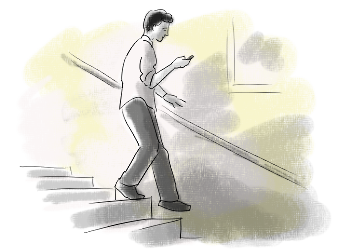
Leon is running down the staircase while sending a message from his mobile, and…what was bound to happen materialises: he has a nasty fall.
Click on either pinyin or characters to listen to individual words. The words are listed in the order in which they appear in the dialogue.
Hover the mouse over the Chinese characters for a second to see the pinyin version of that line. You can also click on the right-hand button for all pinyin to be displayed.
Leon:
哎呀……哎呦!
Wu:
啊!Leon!你没事吧?怎么了?
Leon:
哎呦…… 哎呦……
Wu:
来,慢一点,慢一点,坐在这里。你摔到哪儿了?
Leon:
我觉得我摔到背了,右边手臂也擦了一下。哎呦……
Wu:
哎呀,Leon, 你头上有点出血。快用这块毛巾止一下血,我扶你去休息室。我叫小陈去医务室找医生。
(In the rest room.)
Chen:
哎呀,Leon,你怎么了?医生马上就来了。
Leon:
我刚才一边下楼一边发短信,所以一不小心从楼梯上摔下来了。
Chen:
哦,看上去挺严重的。你现在觉得疼吗?
Leon:
我的背和右边手臂有点疼,头上有点出血,其他还好吧。
(The nurse arrives.)
Nurse:
你好,他们说你刚才摔了一跤,我来看看。
Leon:
你好,不好意思麻烦你了,都是我自己的错。
Nurse:
我先检查一下,然后看看下一步该做什么。你抬抬手臂试试,疼吗?
Leon:
嗯,有一点。
Nurse:
现在伸伸腿,疼吗?
Leon:
嗯,我的背很疼。
Nurse:
你头晕吗?
Leon:
我头不晕,不过有点疼,我觉得有点恶心。
Nurse:
我觉得你应该去医院检查一下。那里的医生会给你做透视,看看有没有骨折,也会给你做扫描,看看有没有脑震荡。现在就去。你应该没什么大问题,但是检查一下才放心。
Leon:
嗯……好吧。
Chen:
Leon, 我陪你去华山医院看急诊吧,我去跟宋经理请个假,然后叫辆车。你能走路吗?
Leon:
嗯,没问题。医生,小吴,谢谢你们帮忙。
Leon:
Oh no….! Ouch!
Wu:
Oh…! Leon! Are you OK? What happened?
Leon:
Ouch…Ouch…
Wu:
Here, slowly, slowly, sit here. Where did you hurt yourself when you fell?
Leon:
I think I have hurt my back, and my right arm is a bit scratched too…Ouch…
Wu:
Oh, Leon, your head is bleeding. Stop the blood with this towel here and I'll take you to the rest room. I'll get Chen to go to the first-aid room (lit. medical room) and call the nurse (lit. doctor. Note that a nurse is called 'doctor' sometimes.)
(In the rest room.)
Chen:
Oh, Leon, what happened? The nurse is coming straightaway.
Leon:
Well, I was texting while coming down the stairs just now. I missed a step and fell really badly.
Chen:
Oh, it seems serious. Are you in any pain now?
Leon:
My back and my right arm hurt, and my head is bleeding a bit but everything else is fine.
(The nurse arrives.)
Nurse:
Hello. They told me that you had a fall. Let me have a look.
Leon:
Hello. I am sorry to cause any trouble. This was so silly of me.
Nurse:
First of all I need to check a few things and then we'll see what to do. Try to raise your arms, does it hurt?
Leon:
Yes, a little bit.
Nurse:
Now stretch your legs, does it hurt?
Leon:
Yes, my back really hurts a lot.
Nurse:
Do you feel dizzy?
Leon:
Not really, but my head hurts and I have some nausea.
Nurse:
I think you should go to the hospital. The doctors there will organise some X-rays to check for any possible broken bones and also a scan for any possible concussion. Better to do this straightaway. You will probably be all right but it is better to make sure.
Leon:
Umm…OK.
Chen:
Leon, I'll accompany you to the emergency department at Huashan Hospital. I'll ask for some time off from Manager Song and call a taxi. Can you walk?
Leon:
Yes, no problem. Thank you very much for your help Doctor and Wu.
These are notes about potentially difficult key expressions. They are listed in the order in which they appear in the dialogue.
1. 一点
慢一点。Slowly.
一点 means a little bit and it is often put after verbs or adjectives in order-giving sentences.
高一点!A bit higher!
多一点!More!
快一点!Hurry up!
2. 摔到
你摔到哪儿了?Where did you hurt yourself when you fell?
我摔到背了。I hurt my back when I fell.
摔 means to fall. 摔到 is followed by a part of the body to indicate where the injury occured.
3. 就
医生马上就来了。The nurse is coming straightaway.
就 is used here to convey the idea that an action is swift. It is often used together with 马上 immediately.
4. 一边……一边……
我刚才一边下楼一边发短信,I was texting while coming down the stairs just now.
一边……一边…… are put before two actions that happen at the same time, meaning …while….
5. 一不小心
我一不小心心从楼梯上摔下来了。 lit. I carelessly fell off the stairs.
小心 means careful and 不小心 means careless. 一(个)不小心 lit. means one careless (moment) and is used when talking about some small accident.
6. 了
你怎么了?What happened?
医生马上就来了。The doctor is coming straightaway.
我一不小心从楼梯上摔下来了。(lit. I carelessly fell off the stairs.)
了 in the above three sentences has two different functions. In the first two sentences, 了 indicates a change of state, i.e. What has happened to you? The doctor will come soon (from his office).
了 in the last example indicates the completion of an action, i.e. falling off.
7. 摔跤
他们说你刚才摔了一跤,我来看看。They told me that you had a fall. Let me have a look.
摔跤 means to fall, (lit. to fall a fall). 摔 is the verb to fall and 跤 is the noun a fall. There can be extra words between them. e.g.
摔了一跤 to have had a fall
摔了一大跤 to have had a bad fall
Note that the completion aspect marker 了 is put straight after the verb 摔.
8. 抬抬 伸伸 试试
你抬抬手臂试试,疼吗?Try to raise your arms, does it hurt?
现在伸伸腿,疼吗?Now stretch your legs, does it hurt?
One-syllable verbs are often repeated to indicate a short duration.
9. 会
那里的医生会给你做透视,也会给你做扫描。The doctors there will organise some X-rays and a scan.
会 lit. can is used here to indicate that something is going to happen in the immediate future. Its two synonyms 可以 and 能 cannot be used for this purpose.
10. 才
你应该没什么大问题,但是检查一下才放心。You will probably be all right but it is better to make sure.
才 is used here to indicate that the realisation of something is potentially difficult, i.e. only possible when the first condition is fulfilled.
11. 请个假 叫辆车
我去跟宋经理请个假,然后叫辆车。I'll ask for some time off from Manager Song and call a taxi.
请假 means to ask for leave and 叫车 means to get a taxi. Both are fixed verb object expressions. The noun is preceded by a measure word, the numeral ‘one’ is usually dropped.
12. 能
你能走路吗?Can you walk?
能 here means 'to manage to'. Its two near synonyms 会 and 可以 cannot be used for this purpose. Compare:
这个孩子会走路了吗?Can this baby walk yet?
骨折多久可以走路?If I have a fracture, how soon can I (am I allowed to) walk?
Fill in the gaps
Listen to the dialogue and complete the following paragraph by dragging the suitable expressions into the blanks. You can listen to the audio to check your answers. Click on 帮助 if you need to access the English translation.
You require the latest flash player to view this activity