Recommending a friend for a holiday visit
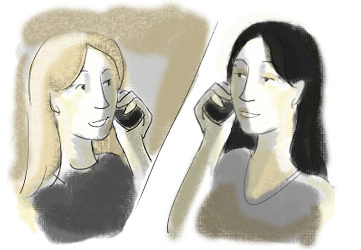
Lilly rings her former colleague Wu to tell her about her friend Gemma who will be visiting Shanghai soon. Gemma also plans to visit Hangzhou and would appreciate meeting a local person for advice during her stay.
Click on either pinyin or characters to listen to individual words. The words are listed in the order in which they appear in the dialogue.
Hover the mouse over the Chinese characters for a second to see the pinyin version of that line. You can also click on the right-hand button for all pinyin to be displayed.
Lilly:
Hi,小吴!我是Lilly。你好吗?
Wu:
哦,Lilly!你打来我太高兴了!我很好,你怎么样?你是不是要来中国了?
Lilly:
不是,我这次打电话是为了我的一个朋友,她叫Gemma,她两周后会去中国度假,她现在兴奋得不得了。
Wu:
哦,是吗?她会来上海吗?
Lilly:
是的。她这个月22号到北京,在北京待三天后就会去上海,我在想她去上海的时候能不能麻烦你照应一下?
Wu:
没问题!我很乐意陪她在上海玩儿。她目前自己有没有什么计划?
Lilly:
我只知道她还想去杭州看看,她的行程安排能不能麻烦你帮忙?
Wu:
没问题,我一定尽力而为,她在这里的时候我肯定会照顾好她的!
Lilly:
太棒了,谢谢你,小吴!你们会相处得很好的。我能不能把你的邮件地址给她?这样你们就可以直接联系了。
Wu:
好主意。有什么新情况我也会告诉你的。
Lilly:
太好了。非常感谢你小吴,我们再联系。
Wu:
不客气,回头再聊。
Lilly:
Hi Wu! It’s Lilly here. Are you well?
Wu:
Oh Lilly! I am so pleased to hear from you! Yes I am very well. What about you? Are you coming to China?
Lilly:
No, I am ringing about my friend Gemma this time. She will be going to China for a holiday in a fortnight’s time. She is really excited about it all.
Wu:
Oh right! Will she be coming to Shanghai?
Lilly:
Yes, indeed. She will arrive in Beijing on Monday 22nd but after 3 days she will travel to Shanghai and I wanted to ask you if she could call on you when she is there.
Wu:
No problem! I would love to show her around Shanghai. Has she already got some plans for her stay?
Lilly:
All I know is that she wants to go to Hangzhou at some stage and I wanted to ask you if you could help her with her itinerary!
Wu:
Of course, I'll do my best. I’ll definitely take good care of her while she is here.
Lilly:
That's great. Thank you, Wu. I am sure you will get on very well. Can I give her your email address so that you can start talking to each other straightaway?
Wu:
Good idea. I’ll also keep you informed.
Lilly:
Fantastic! Thank you very much Wu. Talk to you soon.
Wu:
You are welcome. Bye for now.
These are notes about potentially difficult key expressions. They are listed in the order in which they appear in the dialogue.
1. 要
你是不是要来中国了? Are you coming to China?
要 here does not mean 'to want'. It indicates that something is going to take place in the near future.
要下雨了。 It's going to rain (soon).
2. 会
她两周后会去中国度假。 She will be going to China for a holiday in a fortnight's time.
她在北京待三天后就会去上海。 After three days in Beijing she will travel to Shanghai.
有什么新情况我会告诉你的。 I'll keep you informed.
The use of 会 in these sentences always indicates that something is planned.
3. 不得了
她现在兴奋得不得了。 She is really excited about it all.
不得了 means 'extremely'. It is used as an adverbial expression to indicate an amplification degree. Note that 得 within this expression is pronounced as dé and 了 is pronounced as liǎo.
4. 再
回头再聊。 Talk to you again soon.
再 means 'again'. Note that 再 is used for actions in the future, while 又 which also means 'again', is used for actions in the past.
回头 (lit. turn one’s head) means 'in a short while'.
Key verbs
Select the correct English translation for the following verbs. Click on each verb to listen to it. Check your answers.
check Answers
reset Answers
True or False
Decide whether the following statements are true, false or not mentioned according to the dialogue. Click on the audio button to hear each statement. You can also click on 帮助 to see the English translation. Check your answers.
hint 1
Lilly is going to China for a holiday in two weeks time.
hint 3
Gemma will go to Beijing first, and to Shanghai from there.
hint 4
Gemma will stay in Shanghai for three days.
hint 5
Lilly will help Gemma with her itinerary.
check Answers
reset Answers