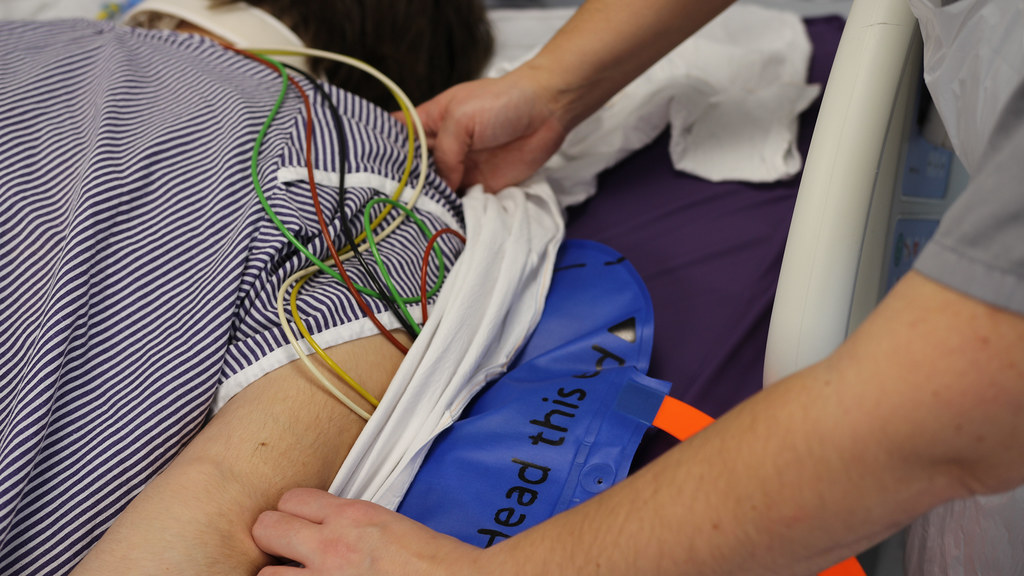
An innovative inflatable repositioning device developed by researchers and clinicians at the University of Bath and Royal United Hospitals Bath NHS Foundation Trust could significantly reduce the staff required to care for proned, ventilated patients, according to preliminary findings from a National Institute for Health and Care Research (NIHR)-funded clinical trial.
When proned, patients are placed on their front for 16 hours a day for up to five days. To reduce the likelihood of pressure sores, NHS guidance requires patients be repositioned up to seven times a day. The BathMat has been designed to free up intensive care teams, helping patients receive more consistent repositioning, even during periods of workforce pressure.
The trial, which concluded in June this year, involved 30 patients and around 160 repositioning procedures. Researchers found the BathMat reduced the number of staff needed to reposition proned, ventilated patients from five people to three, while saving an hour of staff time per repositioning exercise.
Dr Alexander Lunt, Senior Lecturer at the University of Bath and lead engineer on the project, said: “The BathMat was inspired by the challenges intensive care teams faced during the COVID-19 pandemic, many of which remain today as services continue to operate under significant workforce pressure. By bringing together clinicians, engineers and researchers, we've developed a practical solution to a longstanding challenge in critical care.
These early clinical results show that we can safely reduce the number of staff required to reposition ventilated patients while maintaining high standards of care. We believe BathMat has the potential to make prone ventilation more accessible, more consistent and less physically demanding for healthcare professionals, ultimately benefiting patients across the NHS.”
Addressing an ICU challenge
Prone ventilation involves lying a sedated and ventilated patient on their front and is a widely used treatment for severe respiratory failure and acute respiratory distress syndrome (ARDS). Around 16,500 patients per year benefit from this treatment, which reduces mortality by around 17%. However, patients must be repositioned every two to four hours to prevent pressure injuries, a labour-intensive process that can require up to seven staff members and take as long as an hour.
The BathMat is an inflatable pillow that sits beneath the patient's chest and abdomen, gently raising the patient and allowing as few as two staff members to reposition them.
Dr Jerome Condry, an Anaesthetics Registrar and Research Fellow at the Royal United Hospitals Bath and Chief Investigator on the clinical trial, said: “These early findings are extremely encouraging. Prone ventilation can be a life-saving treatment for patients with severe respiratory failure, but safe and regular repositioning is essential to achieving the best outcomes.
“Evidence suggests that patients with complex care needs or a high body mass index may have reduced access to this treatment because of the resources required to deliver it. Our work aims to help close that gap while improving the care provided to all proned patients.
“The BathMat has the potential to make repositioning faster, safer and less physically demanding for staff. Clinical teams using the device have described it as 'revolutionary', enabling them to deliver consistently high-quality care to all proned patients. Once the device is in routine use, the BathMat has the potential to deliver even greater benefits for patients and staff than we saw in this trial.”
Joanna Smart, Programme Director for NIHR Invention for Innovation (i4i), said: "The BathMat is such a brilliant innovation, and the early results from this NIHR-funded trial are really encouraging, showing that the device can help intensive care teams reposition patients more consistently while reducing the number of staff and staff time required.
“It is really important to support the development and testing of innovations like this, which have the potential to improve care for critically ill patients while making the best use of NHS resources."
Advancing the BathMat
Looking to the future, the team plans to commercialise the technology through a University of Bath and Royal United Hospitals Bath spin-out company, making the BathMat available to NHS hospitals in the coming years.
Alongside this, they are exploring a next-generation version that incorporates pressure-sensing technology, which could provide clinicians with real-time pressure maps across a patient's body, supporting more personalised treatment. In the longer term, researchers hope the technology could identify and automatically relieve pressure hotspots before injury occurs.