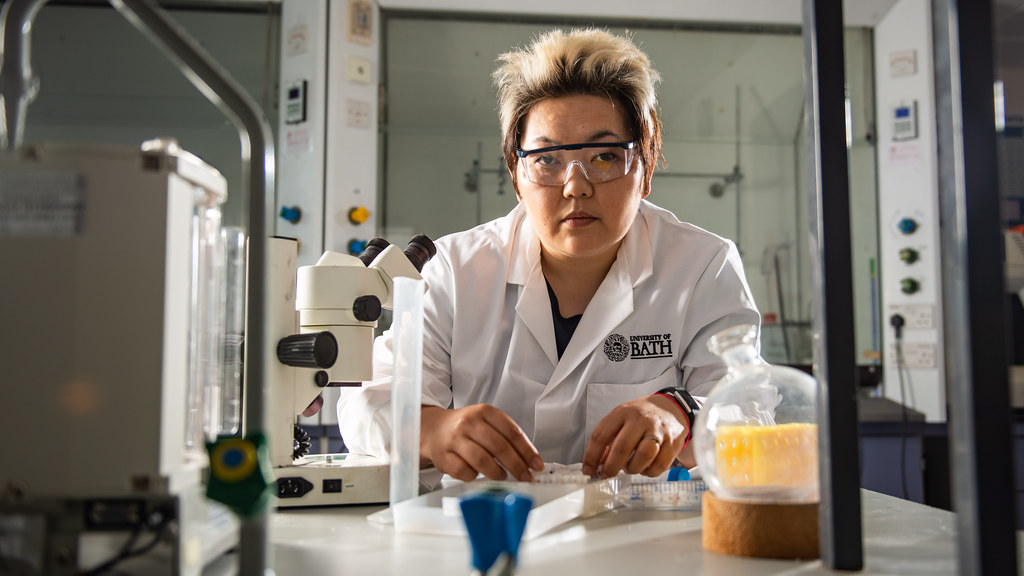
Dr Asel Sartbaeva and her team from the University of Bath, together with Spin Up Science, launch EnsiliTech today (21 July 2022). The spinout company aims to make vaccines that are safe and stable at all temperatures, and to bring its ground-breaking technology to market within the next few years.
Dr Sartbaeva, a Chemistry researcher at Bath and now CEO of EnsiliTech, has spent the past decade working on a technique – known as ensilication – that aims to prevent vaccines from ‘spoiling’, even after they’ve been out of the fridge for three years. Her technique involves encasing a vaccine’s active protein in a silica shell (simple sand) which keeps the structure intact whether the formulation is stored at room temperature or heated to 100°C.
Vaccines are notoriously difficult to transport to remote or dangerous places, as they generally degrade when they are left out of the fridge or the deep freeze (vaccines using new RNA technology, such as the Covid-19 Pfizer-BioNTech vaccine, need to be kept at extremely low temperatures). At 8°C or above, most vaccine proteins unravel fast, making the medication both unsafe and ineffective.
When vaccines are sent to low- or middle-income countries, the ‘cold chain’ transportation process often fails at some point between vaccine manufacture and endpoint destination. As a result, 50% of vaccine doses are discarded and millions of children around the world miss out on life-saving inoculations.
“This is a huge problem, and one we've set out to solve,” explains Dr Sartbaeva. “EnsiliTech is a wonderful opportunity for us to concentrate on what we’ve been promising and bring our vision to life.”
The hope is that the technology to silica-wrap proteins will eventually be adopted to store and transport all childhood vaccines, as well as other protein-based products, such as therapeutic antibodies, diagnostic proteins (such as those used in lateral flow tests) and animal vaccines.
EnsiliTech is starting life in Dr Sartbaeva’s lab at the University of Bath but will soon move to a Science Creates incubator in Bristol – a laboratory facility targeted at start-up science and technology businesses.
"EnsiliTech's technology is a huge leap forward and offers the possibility to increase patient access to life saving medicines and vaccines. We are incredibly excited to support this driven team to realise their vision for the future.” Said Dr. Ben Miles, CEO of Spin Up Science.
“Our initial focus will be on oral animal vaccines, and we’re hopeful that we’ll have a finished product within two years. After that, our full attention will be on human vaccines, antibodies and diagnostic proteins,” says Dr Sartbaeva.
Dr Sartbaeva was funded through Innovate UK’s ICURe (Innovation to Commercialisation of University Research) programme, an initiative aimed at research teams from UK universities with commercially promising ideas. Dr Sartbaeva's research commercialisation and the subsequent spin-out of EnsiliTech have been supported by the Technology Transfer team in Research and Innovation Services (RIS) at the University of Bath.
EnsiliTech has started raising investments and have recently launched the pre-seed round of investments. If you are interested in investing in EnsiliTech, please contact asel@ensilitech.com.