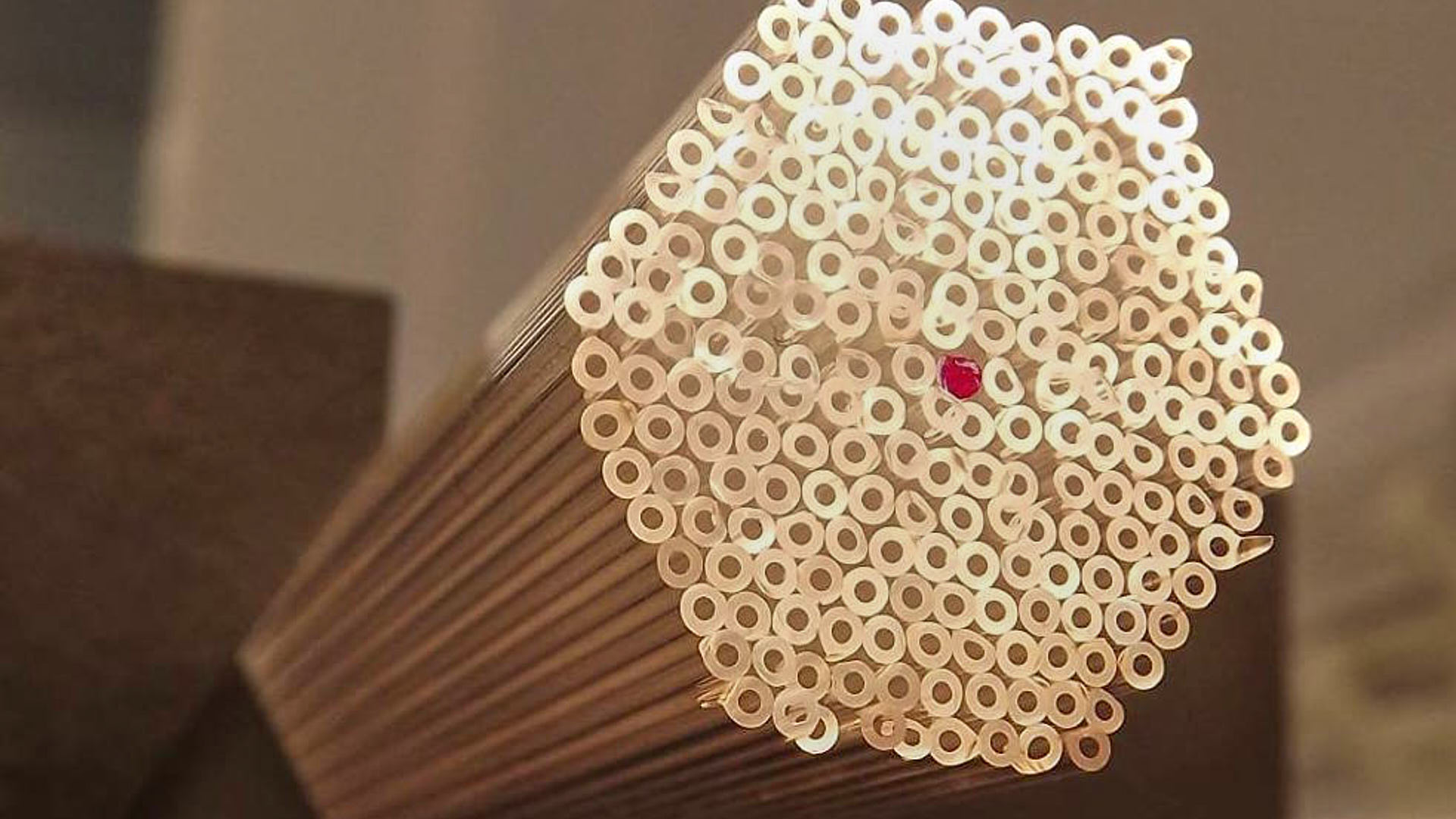
Based in the Department of Physics, we have a research-grade facility for making speciality optical fibre. We use the facility to process raw materials, usually silica glass tubes and doped silica rods, into flexible optical fibre that guides light along its length. We make many different types of fibre, most of which is very different to conventional telecommunications fibre and often incorporates a microstructure.
Capabilities
Housed within a cleanroom suite on campus, the facility runs two drawing towers with furnaces exceeding 2100 °C. One tower is suitable for forming inflexible components such as capillaries and preforms, while the other has the winding gear required to collect fibre as it is drawn as well as apparatus for applying and curing a polymer coating to protect it. We use the stack-and-draw technique to fabricate a wide range of specialty fibres from silica glass, including:
- Hollow-core fibres
- Photonic crystal fibres
- Imaging fibres
- Non-standard single-core and multi-core fibres
Working with companies
The facility has an established track record of working directly with industry partners, including small and medium sized enterprises (SMEs) and large enterprises, to develop fibres that cannot be sourced from commercial suppliers. We offer access to world-class fabrication capability alongside photonics expertise. Collaborations can take several forms, including:
- Joint research and development projects
- Contracted fabrication work
- Ad-hoc facility access and technical support
Academic collaborations
Alongside our industry partnerships, the facility supports a wide network of academic collaborators, both UK-based and international, allowing researchers to access our fabrication capability as part of funded project work and grant proposals.
50:50 industry PhD studentships: We also offer a route for companies to co-fund PhD studentships, with costs shared equally between the University and the industry partner. Students are embedded in real fabrication research from day one, giving partners direct access to emerging talent and a deep connection to the facility's capabilities.
Research-Led Training Environment
A core principle of the facility is the active involvement of researchers in the fabrication process. We strongly encourage PhD students, postdoctoral researchers, and long-term academic visitors to gain hands-on experience with the facility. This approach provides valuable insight into fibre fabrication while fostering innovation and helping shape future research directions.