
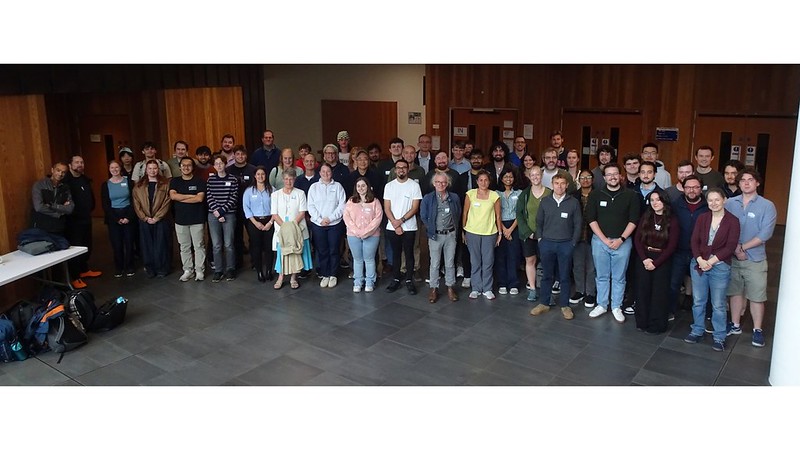
On September 7-8, the Bath Astrophysics Group hosted the UK / Ireland Astrophysics Transients Meeting 2026 at the Chancellor’s Building. The conference is the third iteration of what is now becoming a traditional gathering at a UK university of the UK and Ireland communities of experts on cosmic explosions from massive stars, colliding stars, stars venturing too close to a black hole and getting disrupted, and other sudden extreme events briefly appearing in the sky. Astrophysical transients such as these can be challenging to catch on time with telescopes, and sometimes even harder to explain.
The meeting hosted over eighty visitors from a broad range of institutes, including the Universities of Oxford, Cambridge, Leicester, Birmingham and Southampton, Queen’s University of Belfast, Liverpool John Moores University and various others. One of the aims of the meeting was to provide a platform with ample time reserved for early career researchers to discuss their work. As astrophysics Research Group Leader and lead organiser of the meeting Dr Hendrik van Eerten says, “it has been very inspiring to learn from so many young researchers about all the collaboration and promising work that is being done by the UK and Ireland community. Whether it is about the next generation of observatories coming on-line and set to generate massive amounts of data, or about the ever-increasing zoo of high-energy phenomena detected in our galaxy and beyond, there is no doubt that we’re collectively up to the challenge.’’
High-Energy astrophysics of transients has been a strength of the Bath Astrophysics group since it was founded. The meeting has been dedicated to one of the group’s key members working in this area, Dr Patricia Schady, who took the initiative with Dr Van Eerten to organise the meeting, but who had passed away unexpectedly early March. Dr Schady’s impact in the field and her time at the University of Bath were the subject of the final session on Monday.
The UK / Ireland Astrophysics Transients Meeting was directly followed by another gathering of experts, this time on all aspects of neutron stars. The SPINS-UK meeting (“Science Possibilities Investigating Neutron Stars in the United Kingdom”), was led by Dr David Tsang from the Astrophysics Group. The three-day workshop featured new results from 26 neutron star experts ranging from senior academics to graduate students. Key topics included observational properties of radio pulsars, and gravitational-wave sources, glitch theory and superfluidity in neutron stars, as well as dark matter and exotic dense matter physics that can be probed by measurements of neutron stars.