
It’s July 15 2026. It’s been another hot day in an already blistering summer. England are playing in the World Cup semi-final later this evening, but right now it’s 6pm and I’m in an air-conditioned lecture room at the University of Bath, watching the audience arrive for a screening of the People’s Emergency Briefing.
I'm a month into an 8-week summer placement with the Bath Institute of Sustainability and Climate Change (ISCC). My placement project has been working with Professor Lorraine Whitmarsh and team, analysing the data that has been collected from thousands of People’s Emergency Briefing screenings that have been held across the UK since the film was launched in April.
Despite the football, roughly a hundred people fill the room. I’ve been working with the data for weeks now but there’s something quite different about seeing the project exist outside a spreadsheet. Looking around, one thing is immediately obvious: the audience are older. It’s a small, real-life glimpse of something I am also seeing in the wider data, where older adults are over-represented and younger people much less so.
Suddenly, questions about who climate communication reaches - and who it might be missing - feel a lot less abstract.
Knowing vs doing
Through my project, From Climate Evidence to Public Engagement: Evaluating The People's Emergency Briefing, I have had the opportunity to explore both the theory and practice of climate communication. This included reviewing research on climate education, public deliberation and the different ways people engage with climate issues, as well as analysing survey responses collected before and after screenings of The People's Emergency Briefing. Working alongside Dr Richard Clarke, University of Gloucestershire, I helped interpret the findings and identify emerging themes. I also contributed to a CAST briefing paper, translating the evidence into accessible insights and recommendations to support future climate engagement initiatives.
A lot of climate communication starts from the assumption that if people knew more about what was happening, they would be more likely to care and act. But one thing that has become increasingly clear to me through this project is that it is not quite that simple. Many of the people attending the screenings were already concerned about climate change. In fact, our analysis found that screenings were more common in areas where climate worry was already higher.
That could easily be seen as a limitation. If the people turning up are already worried, are we just speaking to people who are already listening?
I don’t think the answer is necessarily yes.
Audience response shift
What interested me was the way people’s responses still shifted after watching the film. Beforehand, 68% of national respondents described themselves as extremely worried about climate change; afterwards, this rose to 83.1%. For nature loss, the equivalent figures rose from 67.8% to 79.9%. People also expected greater disruption across every area we asked about, from food prices and health to national security, jobs and transport. To me, this suggests there is a difference between knowing that climate change is serious and being able to picture what that seriousness could mean for everyday life.
I was also interested in what happened with hope. Climate communication is often talked about as though people need to leave feeling hopeful for it to have “worked”. Our findings were more complicated. Most respondents did feel more hopeful, but 16% felt less hopeful. Yet among that less-hopeful group, around 80% still said they felt more motivated to act, and more than 86% felt more informed and concerned.
I found that particularly interesting. Perhaps good climate communication does not always have to make people feel better. Sometimes taking an issue seriously may feel uncomfortable. The more important question might be what people are able to do with that feeling afterwards.
That is also why the period after the film stood out to me. Respondents who completed the post-film survey later and were therefore more likely to have stayed for discussion, a panel or another activity, were more likely to say they intended to discuss climate and nature with others, contact a political representative or get involved locally. The analysis cannot tell us that discussion itself caused this, but the pattern suggests that simply giving people information may not be the end of the process.
An open door
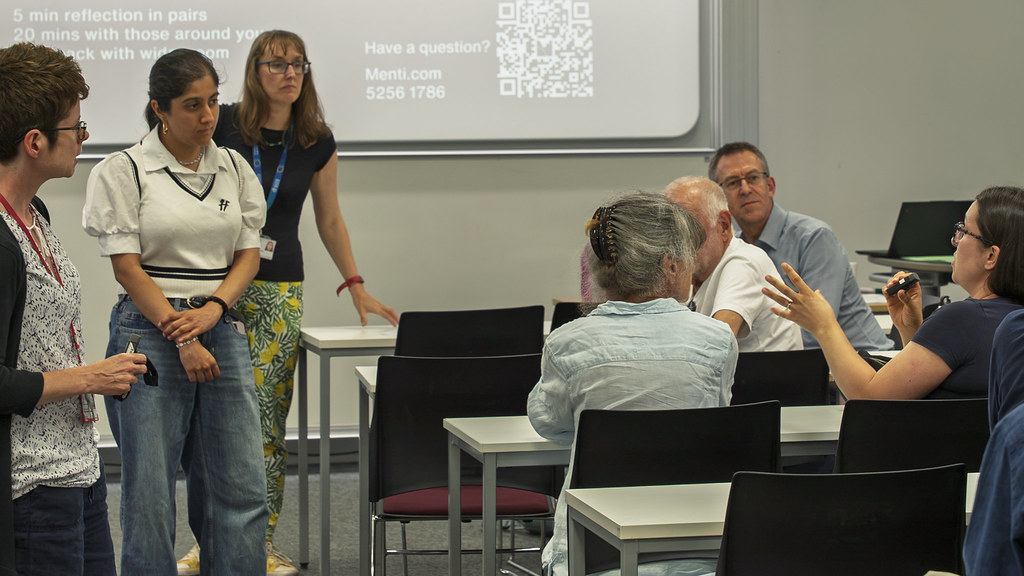
That has probably been my biggest takeaway from working on the People’s Emergency Briefing. A film can open the door, but what happens around it matters too in terms of who is invited into the room, whether people have space to talk through what they have heard, and whether there is an obvious next step once they leave.
And, perhaps just as importantly, who is not in the room?
Seeing the audience at Bath made that question stick with me. A screening can be well attended and still leave whole groups under-represented. Our wider findings point to a similar challenge: screenings were more common in places where climate concern was already high. So, the next stage is not only about deepening engagement among people who already care but finding ways of taking these conversations into spaces where they may not already be happening - workplaces, schools, faith groups, community organisations and other local networks.
Personally, that is where the project becomes especially interesting. The question is no longer simply: how do we make people care about climate change? It is also - who are we reaching, who are we not reaching, and how do we help concern become conversation, and conversation become something people feel able to act on?
About The People's Emergency Briefing
The People's Emergency Briefing grew out of the National Emergency Briefing (NEB), an expert-led briefing held in Westminster in November 2025. Ten leading experts briefed more than 1,200 leaders from politics, business, culture, faith, sport and the media on the risks associated with climate and nature loss.
The briefing was adapted into a 50-minute film to reach wider audiences and is now screened in communities across the UK, accompanied by discussion and opportunities for public engagement.
More than 2,000 screenings have taken place to date.
The screening referenced in this case study was hosted by the Institute of Sustainability and Climate Change (ISCC), the Centre for Climate Change and Social Transformations (CAST), the Institute for Policy Research (IPR) and Sustainable Bath. Manali's placement contributed to ongoing research into climate communication and public engagement.
A full briefing on the analysis of the People’s Emergency Briefing survey respondents has been completed and published by CAST: CAST Briefing 48